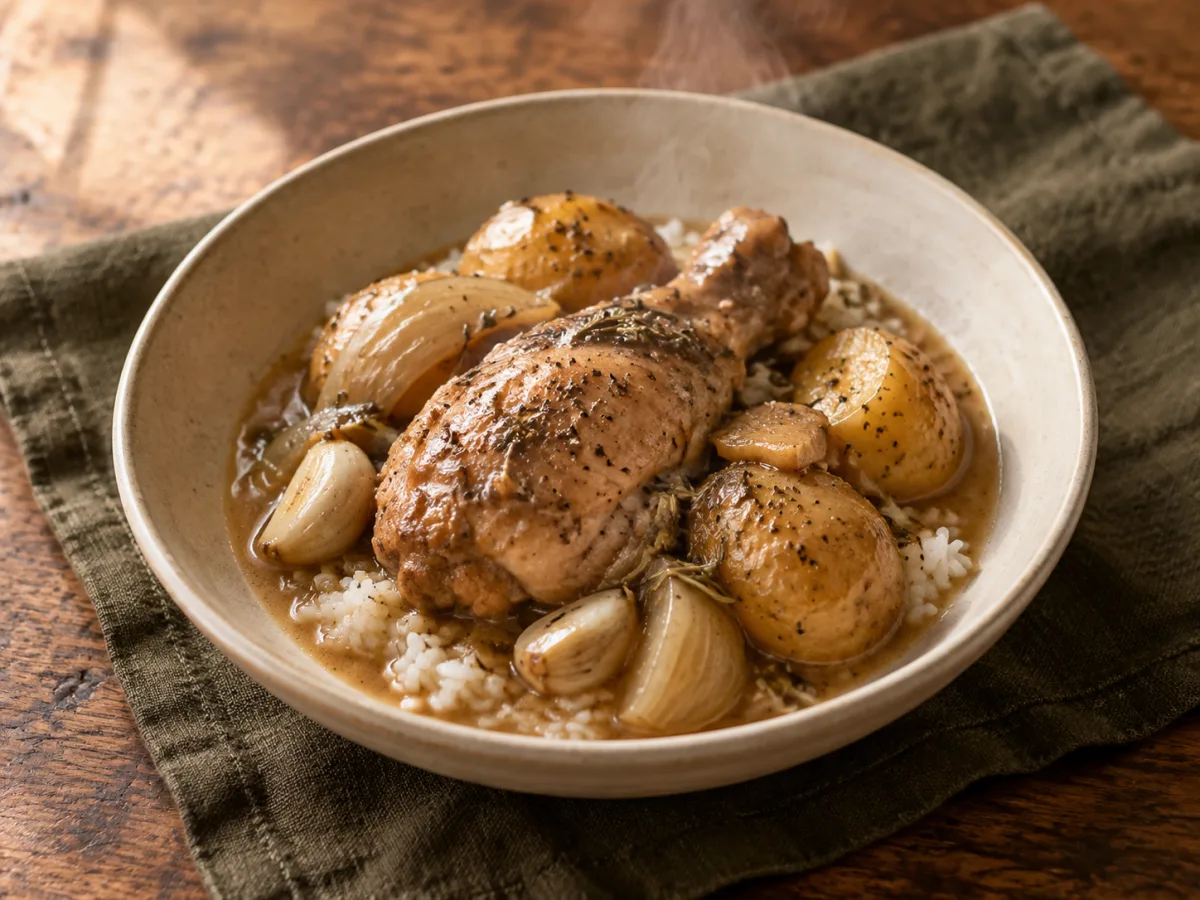
Rosemary Chicken
Rosemary, ginger, garlic, soy, and potatoes. Adapted from a stovetop recipe, given here two ways: a pressure braise for dump-and-go meal prep, and a sauté version that stays faithful to the original.
Status: tested, needs work. The first pressure-cooked version was flat and thin; this revision applies the fixes recorded below but has not yet been verified.
6 servings. Read PREREAD.md first for cooker operation, salt calibration, and the cooling routine.
Which version to cook
The original is a sauté dish — chopped chicken breast and potatoes fried in olive oil with ginger, soy, and rosemary, finished in minutes. That’s a different technique from everything else in this folder, and it can’t be pressure cooked as written: there’s no added liquid beyond a few tablespoons of soy sauce, well under the 3/4 cup the cooker needs to make steam. It would scorch, not pressurise.
- Want dump-and-go meal prep, low smell? Cook Version A. Bone-in thighs, sealed pot, walk away. Softer and saucier than the original.
- Want the dish as written, with distinct pieces? Cook Version B on Sauté. Faster, but it’s open-pot cooking with the smell that implies.
Version A — Pressure braise
Ingredients
For the pressure cook
- 1.2 kg bone-in chicken thighs or drumsticks, skin removed
- 3/4 cup gelled chicken stock — the tested water version came out flat; use water only as a fallback
- 5 tbsp Datu Puti soy sauce if using whole marble potatoes; 6 tbsp if using quartered regular potatoes, or if you halve the marbles
- 1 tbsp ginger, grated or puréed
- 2 tsp dried rosemary
- 2 tsp coarsely crushed black peppercorns
- 3–4 small red onions, quartered
- 15–20 garlic cloves, peeled but left whole
- 600 g marble potatoes, left whole and skin on — or 4 regular potatoes, quartered
To finish, off heat - 2 tbsp butter, or 2 tbsp olive oil to stay closer to the original
- 1 tsp dried rosemary, held back
- 120 ml all-purpose cream (optional, for a gravy)
- A fried egg per serving (optional, from the original — worth it)
Method
- Liquids first. Stock, soy sauce, ginger, 2 tsp rosemary, and crushed pepper into the pot. Stir once.
- Solids on top. Chicken, onions, whole garlic cloves, potatoes. Do not stir again.
- Lid on, valve seated. Poultry or Meat/Stew, then Pressure Time to 8 minutes. Use 7 if you want the chicken pieces fully intact.
- Window cracked, fan pointing out, leave the room.
- Let pressure drop fully on its own. Turn Keep Warm off as soon as it does. Check the thickest piece away from the bone reaches 74°C; if not, return it to Sauté until it does.
- Lift the chicken and potatoes out, then reduce the liquid — see
PREREAD.md. It will be soupy. - Butter or olive oil in, then the reserved 1 tsp of rosemary, stirred through. Return the chicken and potatoes. Add cream now if using, with Sauté off.
- Top each serving with a fried egg if you want the full original treatment.
Total elapsed is roughly 55 minutes hands-off.
Why the rosemary is split
The original recipe’s last instruction is to wait for the rosemary aroma — the fragrance is the point of the dish. Dried rosemary is tough enough to survive 8 minutes under pressure, but its volatile top notes still fade. Putting most in at the start builds the base flavour; the reserved teaspoon at the end restores the aroma you actually want to smell. Same reasoning as holding back a pinch of pepper.
Deviations from the original, and why
- Thighs instead of breast. Breast under pressure with a long natural release goes chalky and dry, with no graceful failure mode. This is not negotiable if you’re pressure cooking.
- Water added. Required for the cooker to pressurise at all.
- Garlic and onion added. Not in the original. They belong in this flavour family and whole garlic cloves cost nothing in effort.
- Potatoes go in raw at the start rather than being fried separately, and they hold their shape at 8 minutes.
Using thigh fillet instead of bone-in
A reasonable swap, and arguably better for meal prep — bones are awkward to eat around when reheating portions from containers, and you get more edible meat per kilo.
What you give up is forgiveness and sauce body. The bone adds thermal mass that widens the timing window, and bone and connective tissue release gelatin that gives the sauce weight.
Three adjustments:
- 1 kg fillet instead of 1.2 kg bone-in.
- 5 minutes instead of 8. Fillet heats faster and the long natural release adds more carryover. Note the potatoes still need their time — whole marbles are fine at 5 minutes plus a full natural release, but halve any large ones.
- Expect a thinner sauce. Plan on the cornstarch slurry.
Never substitute breast fillet for the pressure version. It goes chalky and dry with no graceful failure mode. If you want breast, cook Version B below instead — that’s what the original recipe uses, and sautéing suits it.
Restoring the body you lost
Option 1 — scrap bones. Add a few bony pieces (wings, or a back) alongside the fillets and remove them before serving. Fillet convenience in the dish, gelatin in the sauce, cheap.
Chicken stock is now the written default. Use 3/4 cup stock, never stock plus water. See chicken-stock.md, which is portioned at exactly 3/4 cup a bag for this purpose.
Good boxed or homemade stock carries some gelatin and adds both flavour and body. A bouillon cube carries salt and glutamates but no gelatin — more savoury, equally thin.
Watch the salt stacking, which is a particular risk in this recipe since the soy is already high to season the potatoes. With salted stock or a cube, cut the soy by 1 to 1 1/2 tbsp and taste at the end.
Marble potatoes vs regular
Marble potatoes are the better choice here, and were in the original recipe. Whole baby potatoes around 2–3 cm need roughly 7–10 minutes at pressure, so 8 minutes plus a full natural release cooks them through while the skins keep them intact.
- Leave them whole and skin on, just washed. Less prep than quartering, and the skin is what stops them breaking up.
- Sort for uniform size. Halve anything noticeably larger than the rest, or it will be undercooked.
- They absorb less salt than quartered potatoes, since there’s far less cut surface and the skin slows it further. That’s why the soy drops to 5 tbsp with marbles and stays at 6 with quartered regular potatoes — at 6 tbsp with whole marbles the sauce comes out too salty. The trade-off is milder potato interiors; halve a few if you want them to take on more flavour.
- If yours are big enough that you halve all of them, go to 6 tbsp. Halved marbles are close to quartered regular potatoes in cut surface. Salt has to go in before the pressure cook to reach the potato interiors — soy added at the end seasons the sauce, not the potatoes.
Do not carry marble potatoes over to the 35-minute beef recipes. They disintegrate completely at that length — worse than large quartered ones, because they’re smaller. In the beef, quartered regular potatoes are correct and the partial dissolving is the point.
Next-time improvements
Cooked once as Version A, with thigh fillet straight from frozen, 3 scrap wings for gelatin, and all the marble potatoes halved. It came out flat and thin — fixable at the finish, but better fixed at the source. In order of how much each one mattered:
1. Use homemade chicken stock in place of the water. Still 3/4 cup, never more. This is the highest-value change available and costs nothing in effort — you’re swapping a flavourless ingredient for a flavourful one at identical volume. See chicken-stock.md. Two conditions: the stock has to gel in the fridge to be worth anything for body, and you need to know its salt. Stock built from a rotisserie chicken is not truly unsalted — the bird is brined — but it’s diluted enough that the per-recipe contribution lands under a quarter tablespoon of soy equivalent, so leave the soy as written and taste at the end. The salt-stacking warning above is about boxed stock and cubes, which are salted as a product and need a full tablespoon taken off.
This recipe is also the best home for a lemon-and-thyme stock if that’s the bird you used — lemon, thyme, rosemary, and chicken already belong together, so the acid the folder normally avoids reads as intentional here rather than out of place.
2. Thaw the chicken. Cooking thigh fillet from frozen is safe and works, but the ice is more water in a pot that already has too much, diluting salt and flavour together. Overnight in the fridge, or 20–30 minutes in a sealed bag under cold water. If you do cook from frozen, hold the pressure time at 5 minutes rather than adding time — the standard “add 50% for frozen” advice doesn’t apply, because the longer come-to-pressure does the thawing before the pot ever seals. Expect roughly 30–35 minutes to pressure instead of 25.
3. Treat the boil-down as a standard step, not a rescue. Do it properly on Sauté rather than just ladling. Ladling removes volume without changing concentration — what’s left tastes exactly like what you just tasted. Losing about a third by boiling is what makes the sauce taste like something. Cornstarch slurry after that if it still doesn’t cling; a thin sauce reads as “lacking” even when the seasoning is right, because nothing coats the chicken or the rice.
4. Butter at 3–4 tbsp, and stop treating the cream as optional. This recipe has the thinnest richness backstop in the folder — no browning, no oyster sauce, no mushrooms, cream marked optional — which leaves soy, ginger, and rosemary carrying the entire dish. Fat is doing structural work here, not garnishing.
5. Bloom the reserved rosemary in the butter instead of stirring it into the sauce. The aroma compounds are fat-soluble and release far better into melted butter than into a water-based braise.
On bones vs fillet
Fillet is still the right call for meal prep, for the reason given above — bones are awkward to eat around when reheating from containers. The gelatin problem that creates is better solved with gelled stock than by reverting to bone-in.
Three scrap wings is not enough. That’s the one thing tested here that clearly didn’t work: 5 minutes at pressure is thin margin for collagen conversion, and 3 wings is little collagen to begin with. If you take the scrap-bones route instead of stock, use considerably more of them. Prefer the stock.
If it still tastes flat
2 tbsp oyster sauce in with the liquids closes the savoury gap directly — it’s what the other recipes in this folder lean on for exactly this. It moves the dish away from the original, which is a fair trade if the faithful version keeps reading as thin. Cut the soy by 1 tbsp if you add it.
The fried egg is not garnish. The yolk adds fat and richness to a dish that is short on both. Per PREREAD.md, reach for salt, pepper, or butter when something tastes flat — never acid.
Version B — Sauté, faithful to the original
Cooked entirely on Sauté with no pressure at all, using the inner pot as a pan.
Ingredients
- 1 kg chicken breast, chopped into bite-size pieces
- 4 potatoes, sliced or chopped
- 3 tbsp olive oil, plus more as needed
- 1 tbsp ginger, grated or puréed
- 5–6 tbsp Datu Puti soy sauce
- 2–3 tsp dried rosemary
- 1 tsp crushed black pepper
- Salt for the potatoes
- A fried egg per serving (optional)
Method
- Sauté on, olive oil in, let it heat.
- Potatoes first, salted, cooked until tender. Set aside.
- Ginger in, let it sizzle briefly. Add more oil if it looks dry.
- Chicken in, cooked through — a few minutes, depending on how full the pot is. Check the thickest piece reaches 74°C before serving.
- Soy sauce in. Start with 4 tbsp and taste; adjust from there.
- Potatoes back in.
- Rosemary in, generously.
- Two or three more minutes, until the rosemary aroma comes up. Serve, topped with a fried egg if you like.
What to expect from this on a Dowell
Two honest limitations:
- The potatoes will come out soft rather than golden. See the Sauté section of
PREREAD.mdfor why — short version, the heat is weak and the pot is deep, so a full layer of potatoes steams instead of frying. Cook them in a single layer and don’t crowd the pot, then accept the texture. Genuinely crisp potatoes are outside what this folder does. - This is open-pot cooking, so the smell escapes. Rosemary and ginger are pleasanter aromatics than rendered beef fat, but it’s still 15 minutes uncovered. Window and fan first.
This version is best cooked and eaten fresh. Chicken breast in pieces doesn’t reheat as gracefully as braised thighs, so if this is for meal prep across several days, Version A is the better choice.