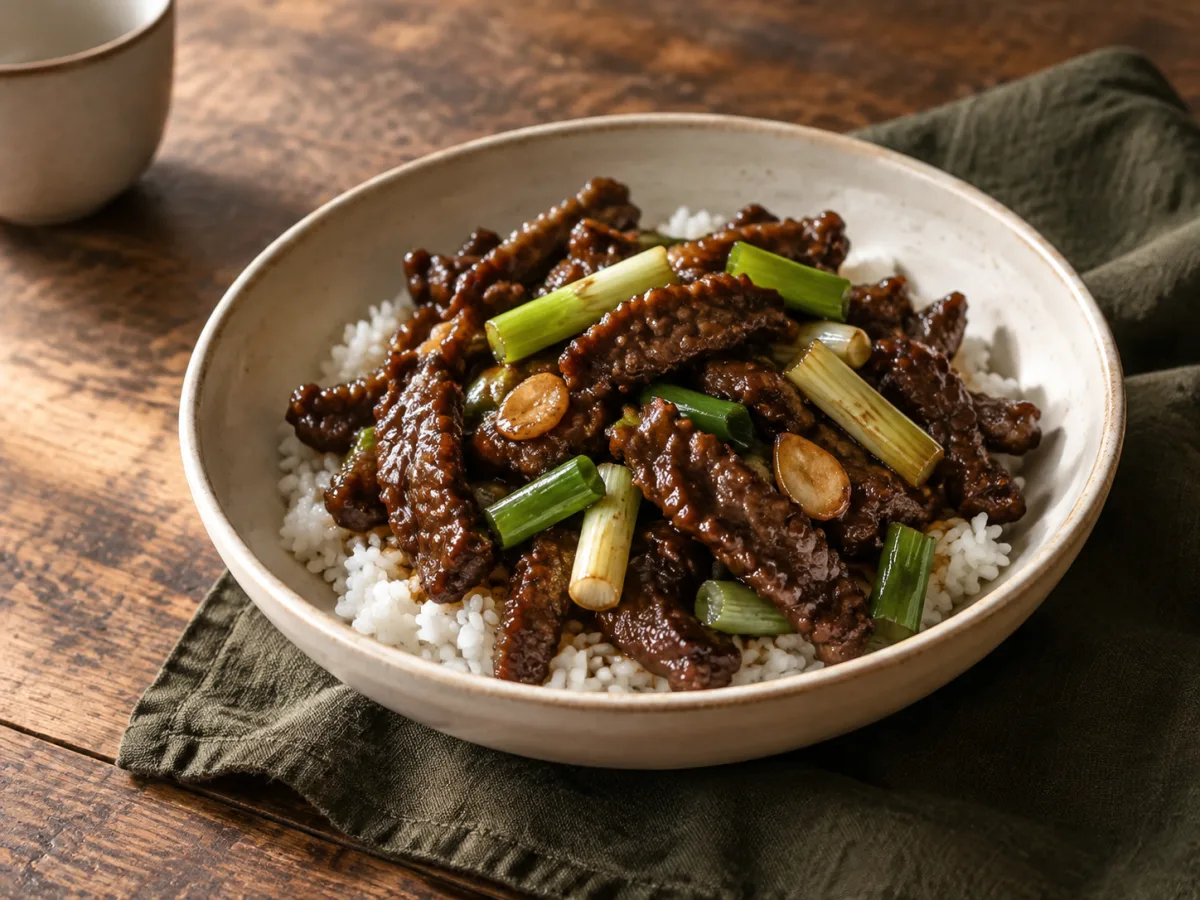
Mongolian Beef
Beef strips tossed in cornstarch and air fried for crisp edges, then folded through a dark soy, brown sugar, ginger, garlic, and scallion sauce reduced separately on the Dowell’s Sauté function. Two appliances, no pressure stage.
Status: untested. Read PREREAD.md first.
6 servings.
Read this before you commit
Restaurant Mongolian beef is velveted, then deep fried in a wok of oil at 180°C, then tossed with the sauce over a burner putting out several times the heat of anything you own. Two parts of that are unreachable here, and it’s worth knowing which before you’re disappointed.
Total oil immersion. Deep frying sets a cornstarch shell in 60–90 seconds because heat arrives from every direction at once through a medium far denser than air. The interior stays barely past rare. An air fryer needs 8–10 minutes to do comparable surface work, so the beef cooks further through and comes out chewier, and the crust is thinner, drier, and more brittle-papery than the shattering coat you get from oil.
Wok hei. The scorched-aromatic character of a wok comes from oil and sauce vapourising and partly combusting against metal at 300°C-plus, right at the pan wall. No enclosed appliance produces it. The finished dish will taste correct and slightly flat at the same time; that missing note is what you’re noticing.
beef-salpicao-style-braise.md opens with the same kind of admission and it applies just as well here: this is genuinely good, and it will scratch the itch, but it is an approximation of a technique this kitchen cannot perform.
Ingredients
For the beef
- 1 kg flank steak or sirloin, sliced 5 mm thick across the grain into strips about 6 cm long
- 1/2 cup cornstarch
- 2 tbsp neutral oil
For the sauce - 1 x 180 ml portion of
chicken-stock.md— this is the folder’s 3/4 cup, used instead of water, never in addition - 3 1/2 tbsp Datu Puti soy sauce
- 5 tbsp brown sugar, packed
- 1 tbsp finely grated ginger, or 8 thin coins
- 8–10 garlic cloves, sliced thin
- 1 tbsp neutral oil
- Whites of 6–8 scallions, cut into 4 cm lengths
To finish, off heat - Greens of the scallions, 4 cm lengths
- 2 tsp cornstarch slurried in 1 tbsp cold water, only if needed
Method
- Slice the beef and pat it thoroughly dry with paper towel. This is not optional — see below.
- Toss the strips with the cornstarch until every surface is dusty and matte, then shake the excess off in a sieve. Loose powder does not become crust; it becomes chalk.
- Toss the coated beef with 2 tbsp of oil until the coating looks faintly damp rather than white. Skipping this is the single most common air-fryer cornstarch failure.
- Preheat the air fryer to 200°C. Cook in a shallow single layer — 3–4 batches at 1 kg — for 8–10 minutes, tossing at the halfway mark. Hold finished batches in a bowl.
- While the batches run, make the sauce. Dowell on Sauté, oil in, then the garlic slices and ginger. One minute only — pull them back from the edge of colouring. Sliced garlic goes bitter fast on Sauté and there’s no rescuing it.
- Stock, soy, and brown sugar in, plus the scallion whites. If the stock is a frozen block, drop it in and give it 3–4 minutes to melt before you judge the level.
- Reduce, uncovered, 8–12 minutes, until it’s syrupy and coats a spoon. Never lock the pressure lid while Sauté is running — if you want a lid at all, rest a plate on top unlatched.
- If it’s still loose, add the cornstarch slurry and cook 1–2 minutes until glossy. Judge this against the sauce alone; it will thin slightly when the beef goes in.
- Sauté OFF. Fold the beef through, along with the scallion greens. Move fast and serve immediately — every second in the sauce costs you crust.
Roughly 55 minutes, most of it batch time running in parallel with the reduction.
Why the cornstarch coat matters
It’s doing three separate jobs, and only one of them is the obvious one.
It dries the surface. Convection cannot brown wet meat, because the surface stays pinned near 100°C until its water has evaporated. Cornstarch absorbs that surface moisture immediately, so the beef starts browning at minute one instead of minute five. This is also why the beef must be patted dry first — wet beef plus cornstarch makes a paste, and paste never crisps.
It becomes the crust. Starch granules absorb water, swell and gelatinise, then dehydrate in the dry heat into a thin rigid porous layer. That layer is the crunch. The meat itself contributes none of it.
It gives the sauce something to hold. A syrupy sauce slides straight off bare beef and pools at the bottom of the bowl. A starch shell is rough and porous and grips a thin film of it, which is why each piece looks glazed rather than wet.
The oil toss is what makes it work in an air fryer. In a deep fryer, hot oil surrounds the coating and sets it. In an air fryer the only fat present is whatever you put there. Dry cornstarch in circulating air just dehydrates into a chalky white dust that tastes of raw starch. Two tablespoons across a kilo is enough to carry heat into the coating and let it fry rather than bake.
Why the sauce is reduced separately
Because the two things need mutually exclusive conditions and cannot share a vessel.
The crust needs dry, moving air and no standing liquid. The sauce needs standing liquid and open evaporation. Cook the beef in the sauce and the coating rehydrates within about a minute — the starch shell reabsorbs water, softens, and dissolves off into the sauce, thickening it while destroying the texture you just spent four batches building. You’d have made a thin braise with cloudy sauce.
There’s also a hard equipment limit. PREREAD.md is explicit that Sauté cannot sear a kilo of anything: the heat is weak and non-adjustable, and the pot is deep and narrow so moisture pools instead of evaporating. Browning a kilo of beef on Sauté is not a slower version of the air fryer, it’s a different and worse outcome. Sauté’s real strengths — small aromatics, boiling a sauce down, cooking out a slurry — are exactly the three jobs it’s given here.
So the split is: air fryer builds texture, Dowell builds sauce, and they meet off heat at the last possible moment. Get the sauce properly syrupy before they meet. A thin sauce soaks the coating; a syrupy one coats it in a film too thin to do much damage in the thirty seconds before it reaches the plate.
Salt stacking
Two salt sources, one of them small but real. Using PREREAD.md’s 2.65 g salt equivalent per tbsp of Datu Puti:
- 3 1/2 tbsp soy = 9.3 g
- One 180 ml stock portion ≈ 200 mg sodium per
chicken-stock.md= ~0.5 g
Total ~9.8 g across roughly 1.15 kg of finished dish (1 kg beef plus the reduced sauce), which is about 0.85%. That sits right at the folder’s target. If you use water instead of stock, leave the soy as written — half a gram is inside the noise.
The sugar is the number to pay attention to, not the salt. Five tablespoons is deliberately less than the restaurant version, which routinely runs closer to double this ratio and reads as dessert-adjacent. The sweet-savoury branch welcomes structural sugar; it doesn’t require candy. Taste before the beef goes in and add a tablespoon if it needs it.
Notes specific to this recipe
- Sliced garlic, not whole cloves. A deliberate break from
PREREAD.md. The whole-clove rule is about acrid mincing over a long braise; this is a one-minute aromatic fry, which is the same technique as the fried garlic topping inbeef-salpicao-style-braise.md. Watch it closely — one minute past pale gold and it’s bitter. - No pepper. Sweet-savoury and pepper-forward fight each other, and this is the sweetest beef dish in the folder.
- Flank or sirloin, not chuck. Nothing here breaks down collagen. A stewing cut in this recipe is just tough beef with a crust on it.
- Slice across the grain. At 5 mm the strips are thick enough that grain direction is the difference between tender and stringy.
- Baking soda velveting is available if you want it — 1/2 tsp per 500 g, rubbed in and left 20 minutes, then rinsed and dried very thoroughly. It raises surface pH and gives a noticeably softer bite. It also adds a rinse-and-dry step to a recipe whose whole texture depends on starting dry, and it fights the folder’s “incredibly easy” goal. Try it once before deciding.
Storage and reheating — the honest weakness
This is the worst recipe in the folder for holding its texture in storage, and it should be picked with that understood. Everything else here either has no crisp component or, like char-siu.md, has a lacquer that survives. This one does not.
The crust starts failing the moment it’s plated. Moisture migrates out of the sauce and out of the beef into the porous starch layer, and separately the gelatinised starch retrogrades as it chills — the granules recrystallise into a denser, softer structure. Within a few hours in the fridge the coating is soft; by day two it is indistinguishable from a thick sauce clinging to the meat. This is physics, not a technique error, and no amount of care at the cooking stage prevents it.
The air fryer partly recovers it. Reheat at 180°C for 4–5 minutes in a shallow layer. Driving the absorbed moisture back off restores some rigidity to the coating. It is a partial recovery — you get maybe half the day-zero texture, and the sauce tightens further and can catch, so keep the layer thin and check at 3 minutes. This is the PREREAD.md case where the microwave rule does not apply. Microwaving heats the water inside the coating and makes it soggier than it already was.
If you want maximum recovery, store the beef and the sauce in separate containers, reheat the beef alone in the air fryer, and warm the sauce in the microwave before combining. That works better than anything else and it is a genuinely fiddly step for a folder built on dump-and-portion. Judge it once and pick a side.
Otherwise cool and store per PREREAD.md, split shallow, freeze half on day one. It freezes acceptably, but the coating suffers further — accept that frozen portions are a saucy beef dish rather than a crisp one. If you want a sweet-savoury beef that actually holds for a week, cook bulgogi.md instead. It has no crust to lose.
Next-time improvements
Nothing yet — untested. After the first cook, record:
- Whether 8–10 minutes at 200°C gave real crust or chalky coating, and whether 2 tbsp of oil was enough.
- How far the sauce reduced in 8–12 minutes on Sauté, and whether the slurry was needed at all.
- Whether 5 tbsp of brown sugar read balanced or thin against the soy.
- How long the crust actually survived once folded through the sauce.
- How much of the texture the air-fryer reheat recovered on day two, and whether storing beef and sauce separately was worth the extra container.
- Whether the stock portion was noticeable at all against this much soy and sugar, or whether water would have done.