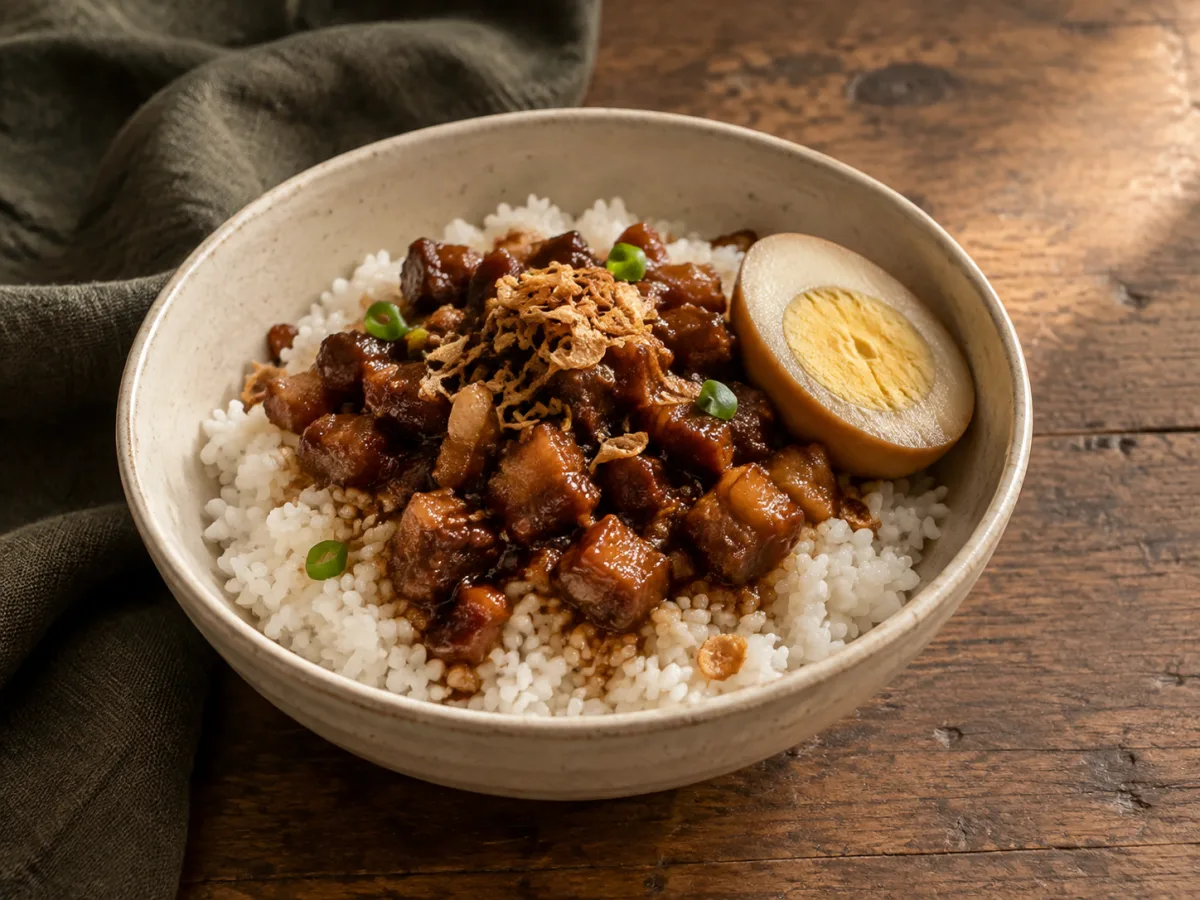
Lu Rou Fan (Taiwanese Braised Pork Rice)
Hand-diced pork belly pressure braised in soy, five-spice, and fried shallots, reduced to a sticky sauce and spooned over rice. Hard-boiled eggs optional, and cheap enough that they may as well go in.
Status: untested. Read PREREAD.md first for cooker operation, salt calibration, and the cooling routine.
6 servings as written, and it will honestly stretch further — see the cost section below.
It is a topping, not a stew
This is the thing to get right before anything else. Lu rou fan is two or three tablespoons of intensely seasoned pork spooned over a bowl of plain rice. It is not a bowl of braise with rice on the side. Every design decision below follows from that:
- The sauce is reduced hard, to a glossy syrup that clings to the dice and soaks a small patch of rice. Volume is the enemy; concentration is the point.
- The pot runs slightly saltier than the folder’s nominal 0.8%, because the plate is mostly unsalted rice. See the salt section.
- The pork is cut small so a small spoonful still has a dozen pieces in it.
If you finish this and it looks like the flagship beef braise — meat sitting in loose liquid — you have not reduced it far enough.
Ingredients
For the pressure cook
- 1 kg pork belly, skin on, hand-diced to roughly 1 cm — pork shoulder also works, see below
- 1 x 180 ml portion of chicken stock, instead of the 3/4 cup of water, not in addition — see
chicken-stock.md - 3 1/2 tbsp Datu Puti soy sauce
- 1 tbsp dark soy sauce (for colour) — if you have none, use 4 1/2 tbsp Datu Puti total and read the note below
- 2 tbsp Shaoxing wine
- 1 1/2 tbsp brown sugar or crushed rock sugar
- 1 tsp five-spice powder
- 1/2 tsp ground white pepper
- 8–10 garlic cloves, peeled but left whole
- 1/2 cup crisp fried shallots, half of them into the pot
To finish - The other half of the fried shallots, kept dry in a jar
- 6 eggs, hard-boiled and peeled (optional)
- 1 spring onion, sliced thin (optional)
Method
- Eggs first, if you’re using them. The Dowell is the only thing you have that can boil an egg, and the pot is free right now. Trivet or steamer basket in, 3/4 cup water under it, eggs on top, Pressure Time 4 minutes, full natural release. Into cold water, peel, set aside. Four minutes plus a natural release lands firmly hard-boiled, which is what you want here — see the egg section.
- Liquids and seasonings first. Stock (a frozen block is fine), both soys, Shaoxing, sugar, five-spice, white pepper. Stir once.
- Solids on top. Diced pork, whole garlic cloves, half the fried shallots. Do not stir again. Sugar on the base is what scorches, and this pot has no burn sensor.
- Lid on, valve seated. Meat/Stew, then Pressure Time to 20 minutes.
- Let pressure drop on its own — roughly 25 minutes at this size. Never quick-release. Turn Keep Warm off.
- Defat, then reduce. There will be a lot of rendered fat and it will look soupy. Ladle the liquid into a tall narrow jar per
PREREAD.md, wait 5 minutes, and spoon off about half the risen fat — not all of it, see below. Return the liquid. - Reduce on Sauté, lid resting on unlatched. Boil it down until it coats a spoon and the dice sit in syrup rather than liquid. Expect 10–15 minutes. This is the step that decides whether the dish works.
- Eggs in during the last 10 minutes of the reduction, turned occasionally so they colour evenly. Do not pressure cook them in the braise.
- Sauté off. Taste. Scatter the reserved fried shallots and spring onion at the plate, not into the pot.
- Cool and store per
PREREAD.md.
Roughly 95 minutes, most of it unattended: ~20 to reach pressure, 20 cooking, ~25 releasing, ~15 reducing. Add 25 for the eggs.
Hand-diced, not ground
Every shortcut version of this dish uses ground pork and every one of them is worse. The reason is mechanical rather than snobbish.
Grinding destroys the fat-and-lean structure that the braise is supposed to reveal. Pork belly is layered: bands of lean separated by bands of fat and connective tissue. Under a long braise the fat renders soft and the collagen between the layers turns to gelatin, so each piece ends up with a soft, slightly sticky, semi-translucent character that plain lean pork cannot produce. A grinder smears those layers into one uniform paste, and there is nothing left to melt within a piece — the fat just leaves.
Mince also fails texturally in the pot. Ground meat has enormous surface area, so its proteins set fast and tight, and long cooking turns it grainy and pebbly. Under pressure with agitation during reduction it goes further and breaks into a slurry. You end up with a bolognese-adjacent sauce with pork grit in it.
1 cm is the number. Big enough that the fat inside a cube has somewhere to go and the piece stays identifiable on the spoon; small enough that a modest spoonful over rice has plenty of pieces. Larger than about 1.5 cm and it stops reading as a topping and starts reading as a stew.
The dicing is the only real labour in this recipe, about 15 minutes with a sharp knife. Partly freezing the belly for 20–30 minutes firms the fat and makes it dramatically easier — soft raw pork fat squashes under the blade rather than cutting.
Shoulder instead of belly is a legitimate swap and cheaper again. It is leaner, so the sauce has less body and the pieces are chewier rather than melting. If you use shoulder, pick the fattiest piece available, cut it the same size, and skim less fat at step 6.
The fried shallots
These are not a garnish. In Taiwan they are the signature of the dish and they do three separate jobs, which is why they go in twice.
- Browned flavour you cannot make in this pot. The Maillard work is already done in the fryer.
PREREAD.mdis clear that Sauté cannot brown at volume and the braises buy depth back some other way — here, fried shallots are that mechanism, and they are far more effective than butter or oyster sauce because the flavour is specifically toasted allium, which is what the dish wants. - Body. The half that goes into the pot dissolves completely. Their starch and their oil thicken the sauce slightly and give it the smooth, faintly sweet background that raw onion cannot —
PREREAD.mdnotes onion dissolves into sweet pulp and dilutes your salt with released water. Pre-fried shallots have already given up their water. - Texture, at the plate. The reserved half goes on last, dry and crisp, against soft pork and soft rice.
Buy them in a jar. This is not a compromise; it is what Taiwanese kitchens do. Frying half a cup of shallots yourself needs a shallow pan of oil at a controlled temperature, andPREREAD.mdis explicit that Sauté is weak, non-adjustable, and pools moisture in a deep narrow pot. You would get pale, oil-logged shallots after a long fiddly stint. If you want to make your own, the air fryer does it better than the cooker: thin-sliced shallots tossed in oil, 160°C, shaken every 3 minutes, pulled the moment they are pale gold — they darken further off the heat, and past gold they turn bitter.
Never stir the reserved crisp ones into the pot. They go soft in under a minute and you have spent the texture for nothing. Keep them in a sealed jar and scatter per portion, including on reheated portions.
Should you brown the pork first?
Short answer: not by default, which is why the frontmatter says appliances: [dowell].
The traditional method renders and browns the pork in a wok before liquid goes anywhere near it, and that browning is real flavour. But 1 kg of 1 cm dice is the worst possible thing to put in an air fryer. Small pieces fall through the basket, they need three or four batches, and the rendered fat — which you want in the sauce — drips into the drawer and gets thrown away. You would spend 40 minutes to make the dish slightly better and measurably drier.
If you do want the browning, brown it as slabs and dice afterwards. Air fry the belly in whole slabs at 200°C for 10–12 minutes, until the surface is properly coloured, then dice. One or two batches, no fall-through, no lost fat, and you still get Maillard on a good fraction of the eventual surface area. The payoff is a deeper, roastier base that makes the five-spice read warmer rather than sharper. Costs about 20 minutes and some smell.
If you take that route, note it in the file the next time you cook it, since the frontmatter as written assumes you didn’t.
The eggs, and why they go in after pressure
Never pressure cook a peeled hard-boiled egg in the braise. Twenty minutes at pressure in salty liquid turns the white leathery and rubbery and drives a grey-brown ring deep into it. The egg comes out looking right and eating like an eraser.
Simmering them in the reduction for 10 minutes gets you everything you actually wanted: colour, a seasoned outer few millimetres, and a whole egg that still has bite. Most of the flavour arrives in the fridge anyway — an egg sitting in the sauce overnight takes on far more than one boiled in it.
Hard-boiled is deliberate, not lazy. Jammy soft yolks are the better egg and they do not survive meal prep; buta-no-kakuni.md covers why in detail. Firm yolks hold the full 3–4 days and reheat without drama, which is the whole point of this folder.
Salt, and why it runs high
Soy is the only significant salt source here. No oyster sauce, no miso, and the stock is only incidentally salty — chicken-stock.md puts a 180 ml portion at roughly 200 mg of sodium, small enough to ignore on a first attempt. So the stacking arithmetic is short: 3 1/2 tbsp Datu Puti at 2.65 g salt equivalent per tbsp is about 9.3 g, plus roughly 2 g from the dark soy, so about 11 g across a finished 1.1 kg. That is close to 1%, slightly above the folder’s nominal 0.8%.
That is on purpose and it is the one calibration deviation in this file. PREREAD.md targets 0.8% so a dish still reads seasoned once rice dilutes it, but it assumes a normal braise-to-rice ratio. Here the ratio is far more extreme — a couple of spoonfuls of pork over a full bowl. At 0.8% the topping would disappear. Taste the sauce before you reduce it: it should read distinctly too salty on its own. On the plate it will not be.
If you have no dark soy, go to 4 1/2 tbsp Datu Puti and accept a lighter colour. Do not try to make up the colour with more sugar; you will get a sweet dish rather than a dark one. See hong-shao-rou.md for a fuller explanation of what dark soy actually does.
Why this is the cheapest thing in the folder
Worth stating plainly, since README.md lists cost per serving as an open thread.
- The cut. Pork belly and pork shoulder are the two cheapest braising cuts available to you, and both are far below beef chuck or shank, which every beef recipe here uses.
- Nothing expensive at the finish. The flagship spends two cans of mushrooms, 2 tbsp of butter, and up to 250 ml of cream after the pressure cook. This dish spends half a jar of fried shallots.
- It stretches. At 1 kg it is sized for the folder’s standard 6 servings, but as a rice topping the same batch comfortably covers 8–10 bowls. The pork-to-rice ratio is a dial, and rice is the cheapest thing in the kitchen. If you portion it at 8, this becomes dramatically cheaper per serving than anything else here.
- Eggs. Cheap protein that costs one extra 25-minute pot cycle and no ingredients.
Where this departs from the authentic version
- No caramel and no wok stage. Traditional lu rou fan starts by rendering the pork and frying it with shallots and sometimes a sugar caramel. Neither is available: Sauté cannot brown at volume, and a caramel in a deep opaque pot on a non-adjustable element is a coin flip. Dark soy supplies the colour and the sugar goes in with the liquids. The optional air-fryer slab browning above is the closest recovery.
- Chicken stock instead of water or the traditional braising liquid. Folder rule, and a straight upgrade — the volume is fixed at 3/4 cup regardless, so the gelatin is free body in a dish that needs a clinging sauce.
- No rice wine lees, no fermented bean curd, no dried shiitake. Some versions use one or more. Fermented bean curd in particular is out on flavour-family grounds —
PREREAD.mdexcludes funky. Dried shiitake would fit and is a fair thing to try; it is left out to keep the ingredient list short. - Shaoxing capped at 2 tbsp. Bigger pours are common. A sealed pot does not evaporate, so alcohol that would boil off in an open simmer simply stays in. The open reduction at step 7 is what cooks it out, and 2 tbsp is what that reduction can comfortably clear.
- Five-spice at 1 tsp, not more. Whole and ground spices extract much harder under pressure than in an open simmer, so a quantity copied from a two-hour stovetop recipe will taste of star anise and nothing else. If 1 tsp reads thin after reducing, add a pinch at the end rather than more at the start.
Notes specific to this recipe
- Keep half the fat.
PREREAD.mdtreats the fat cap as something to remove entirely, and for the beef braises that is right. Here a portion of the rendered pork fat is structural — it is what makes the sauce cling to rice and gives it gloss. Skim about half at step 6, and if you chill it overnight take roughly half the cap rather than all of it. - The skin stays on.
PREREAD.mdsays skin comes off in the braises, but that rule is about chicken skin, which goes pale and flabby without browning. Pork rind under pressure goes fully gelatinous — it is set, not slack, and it is a large part of why this dish has body. Same rule, different material, opposite call. - Pressure time is short because the pieces are small.
PREREAD.mdnotes pressure time tracks piece thickness, not quantity. At 1 cm, 20 minutes is already generous; the collagen in belly gives up fast. - Watch the max fill line if you scale the eggs up. The eggs are a separate cycle, so this only matters if you try to combine them.
- Reheat covered in the microwave. This is a saucy dish and the microwave rule in
PREREAD.mdapplies directly. Nothing here is crisp except the reserved shallots, which never went in the fridge in the first place. - Freezes well. Gelatin and rendered fat both freeze without splitting, and there is no dairy. Freeze half on day one per
PREREAD.md. The eggs are the exception — boiled egg whites go slightly rubbery and weep after freezing, so keep the frozen half egg-free and boil fresh ones later.
Next-time improvements
Nothing yet — untested. After the first cook, record:
- Whether 20 minutes was right at 1 cm dice, or whether the pieces were already falling apart.
- How far you had to reduce, in minutes on Sauté, and whether the sauce actually clung to rice or ran off it.
- How much fat came off, and whether keeping half was too much or too little.
- Whether 3 1/2 tbsp plus dark soy read correctly on the plate rather than in the pot — taste it over rice, not off a spoon.
- Whether the five-spice was balanced or star-anise dominant after pressure.
- Whether the slab pre-brown is worth the 20 minutes, if you tried it.