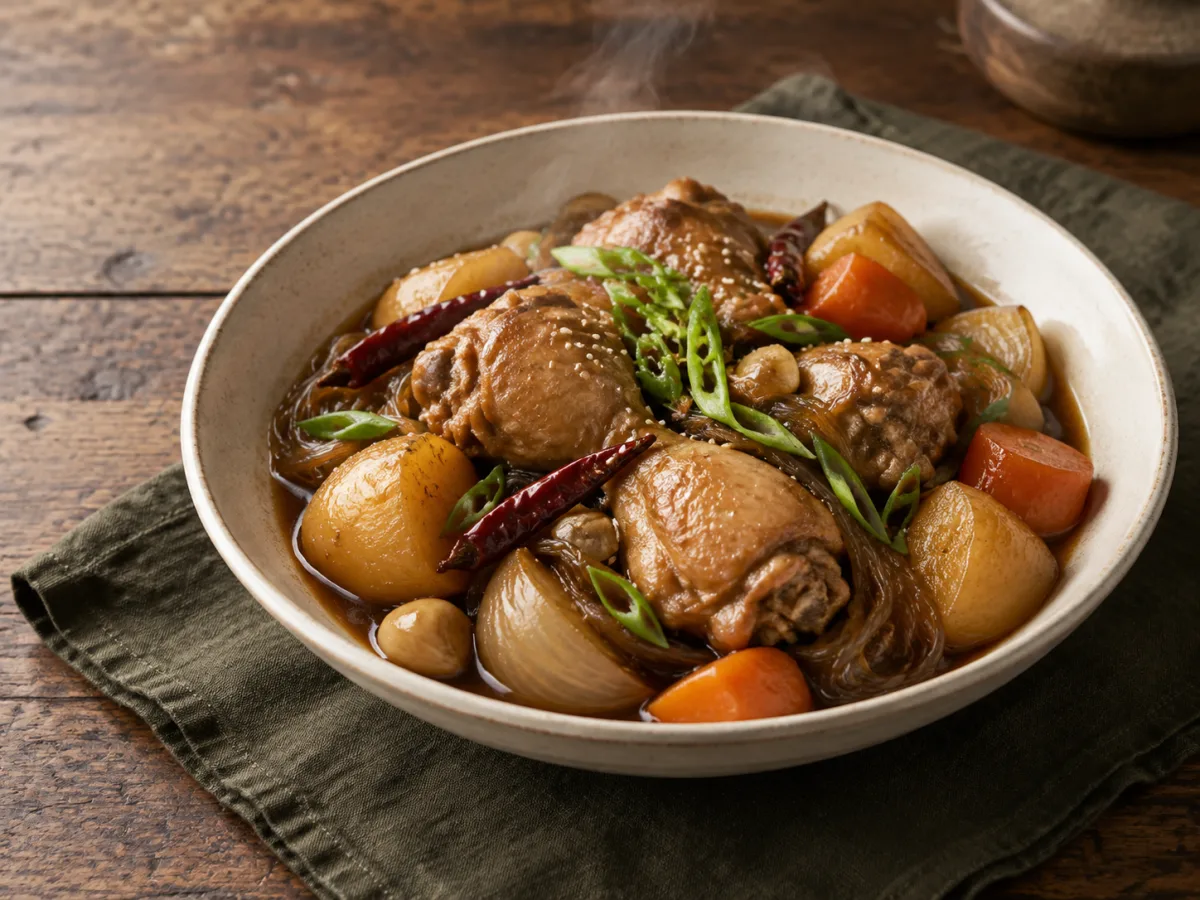
Jjimdak
Andong-style Korean braised chicken — soy, sugar, garlic, ginger, and dried chilli, with potato, carrot, and onion. The dangmyeon glass noodles are cooked one portion at a time at serving rather than in the pot, for reasons that get their own section.
Status: untested. Read PREREAD.md first for cooker operation, salt calibration, and the cooling routine.
6 servings. Uses one 180 ml portion of chicken-stock.md instead of the 3/4 cup of water, never in addition.
Read this before you commit
Jjimdak fits this folder better than almost anything else in it. It’s a soy braise, it’s garlic-heavy, it’s glossy and sweet-savoury, it uses a cut the Dowell is good at, and it’s already a big-pot communal dish rather than something plated to order. Two things need a decision before you cook.
- The noodles do not survive meal prep, and pretending otherwise produces a container of glue on day three. The section below works through the options and lands somewhere that costs you about seven minutes per serving.
- Chicken timing has no margin. This recipe uses the folder’s existing numbers rather than inventing new ones, and the reasoning behind them is in
creamy-garlic-mushroom-chicken.md— worth reading once if you haven’t.
Also worth saying plainly: this is the soy-braised jjimdak, not the gochujang one. Don’t reach for gochujang to make it spicier. That’s dakbokkeumtang, a different dish, and it brings fermented funk and a distinct sourness that the folder’s flavour family excludes on purpose. Heat here comes from dried chilli, which carries none of that.
Ingredients
For the pressure cook
- 1.2 kg bone-in chicken thighs or drumsticks, skin removed — or 1 kg thigh fillet, see below
- One 180 ml portion of chicken stock — see
chicken-stock.md. In frozen is fine. - 6 tbsp Datu Puti soy sauce, plus 1 tbsp held back for the finish
- 3 tbsp brown sugar — or 2 tbsp sugar plus 2 tbsp corn syrup or oligodang if you want more gloss and less sweetness
- 2 tbsp mirin or Korean cooking wine (optional)
- 1 tbsp ginger, grated or puréed
- 15–20 garlic cloves, peeled but left whole
- 4–6 whole dried red chillies, left whole and uncut
- 600 g potatoes (about 3 medium), peeled and cut into large 4 cm chunks
- 1 large carrot (~150 g), cut into rough 2–3 cm chunks
- 2 medium onions (~300 g), cut into wedges through the root
To finish, off heat - The reserved 1 tbsp soy sauce, to taste
- 1 tbsp toasted sesame oil
- 2–3 spring onions, green parts sliced
- 1 tbsp toasted sesame seeds
Per portion, at serving - 30–35 g dry dangmyeon (sweet potato starch glass noodles) — about 200 g for the whole batch, cooked a portion at a time
Method
- Liquids and seasonings first. Stock, 6 tbsp soy, sugar, mirin, ginger. Stir until the sugar is fully dissolved — nothing gritty left sitting on the base. If you’re using the mirin or cooking wine and want to be careful about it, boil it off on Sauté first and turn Sauté off before lidding; the reasoning is in
nikujaga.md, and it matters less here because the quantity is smaller. - Solids on top. Chicken, whole garlic cloves, whole dried chillies, onion wedges, potatoes, carrot. Do not stir again. Check the max fill line — this is a full pot.
- Lid on, valve seated. Poultry or Meat/Stew, then Pressure Time to 8 minutes. Use 7 if you want the pieces fully intact; 5 for thigh fillet.
- Window cracked, fan pointing out, leave the room.
- Let pressure drop fully on its own. The release is part of the cooking here, not just a smell measure. Turn Keep Warm off the moment it drops. Check the thickest piece away from the bone reaches 74°C; if not, return it to Sauté until it does.
- Lift the chicken and potatoes out first, then deal with the liquid — see
PREREAD.md. Cooked thighs shred if you stir around them, and the potato chunks break up. - Reduce on Sauté, or ladle — see the sauce section below for which. Return the chicken and potatoes, and fish out the chillies if you want the heat capped where it is.
- Sauté off. Reserved soy to taste, then the sesame oil, stirred through gently. Sesame oil is an aroma oil and it goes in last, off heat.
- Spring onion greens and sesame seeds at serving, not before.
- Noodles per portion, cooked separately — see below.
Total elapsed is roughly 55 minutes: ~20–25 to reach pressure, 8 cooking, ~20–25 releasing. Same shape as the other two chicken recipes.
The noodles — the real problem in this recipe
Dangmyeon is what makes jjimdak jjimdak, and it is fundamentally incompatible with how this folder stores food. Work through the options rather than taking the answer on faith, because the honest answer isn’t the traditional one.
Why they can’t go in under pressure. Dry dangmyeon absorbs three to four times its weight in water. Two hundred grams of it would drink 500–600 ml — more than three times the liquid this pot starts with, and more than the chicken and vegetables release. You would open the cooker to a dry pot with a scorched base and a solid mass of noodle. Even if you added the liquid to cover it, eight minutes at 115 °C turns starch noodles to paste, and that paste on the base of the pot is exactly the scorching risk PREREAD.md’s loading rule exists to prevent. This one isn’t a preference; it fails outright.
Why they can’t go in at the finish either, if you’re storing them. Adding them on Sauté for five or six minutes at the end is how the dish is actually made, and it works beautifully for something eaten immediately. It fails on two counts here. First, they still need their 500 ml, so you’d have to make a much larger, weaker sauce and then watch the noodles drink it — you’d be diluting a sauce you spent the whole cook concentrating. Second, and worse, they don’t stop absorbing when you stop cooking. Overnight in the fridge they bloat, then the starch retrogrades and they set into a single clumped rubbery block that reheats to either paste or to something you can cut with a spoon. Leftover japchae is the reference point and it’s not a subtle failure.
So: cook them per portion, at serving. No stovetop needed. Put 30–35 g of dry dangmyeon in a deep bowl with about 250 ml of water, cover, and microwave 6–8 minutes until translucent and springy, then drain and spoon the reheated braise over. You can start the noodles and reheat the braise in sequence in the same appliance; the whole thing lands at about seven minutes.
Be honest about the cost. This is the least dump-and-go thing in the folder, and it works against goal one in PREREAD.md. It buys you a braise that behaves like every other recipe here — 3–4 days refrigerated, freezes cleanly, reheats in one covered dish — instead of one that has to be eaten on day one. That’s the trade, and it’s worth taking.
Two sensible middle paths. The decision is per-portion, not per-batch, so you don’t have to pick once:
- Do it the traditional way for whatever you eat fresh. After step 8, lift out the two portions you’re eating today, put 70 g of dangmyeon and a splash of water into the pot with what’s left, and finish it on Sauté for 5–6 minutes. Store the rest noodle-free.
- Skip the noodles entirely and serve it over rice, like everything else here. Less authentic, zero extra work, and the sauce is designed for rice anyway.
Note this stretchesPREREAD.md. It describes the microwave as being for reheating and greens. Cooking noodles is a third job for it, and worth recording once you know whether 6–8 minutes is the right number in your microwave.
If you do put noodles in the pot, the salt maths changes. Two hundred grams of dry noodle becomes roughly 800 g of bland, water-logged starch, which drops a 2.4 kg pot from 0.8% salinity to about 0.6%. You’d need another 1 1/2 to 2 tbsp of soy to stay seasoned. This is a further, quieter argument for keeping them out.
Chicken timing, and bone-in versus fillet
8 minutes at pressure with a full natural release, exactly as in creamy-garlic-mushroom-chicken.md and rosemary-chicken.md. Don’t reinvent this. The short version of the reasoning there: chicken has no wide tender window the way beef chuck does, and a 20–25 minute natural release is itself a substantial amount of cooking, so you cook short and let the release finish the job. Seven minutes if you want the pieces intact rather than falling off the bone. No breast, ever — it goes chalky under pressure and there’s no graceful failure mode.
Bone-in is written as the default here because it’s what Andong jjimdak uses — chopped bone-in chicken, skin on, hacked through the bone — and because bone and connective tissue give the sauce weight that matters in a dish with no cream or butter in it.
Thigh fillet at 5 minutes is probably the better call in this particular recipe, though, and more so than in the other two. The folder’s standing objection to bone-in is that bones are awkward to eat around when you’re reheating portions out of containers; here you’d be eating around them with a bowl of slippery noodles as well. rosemary-chicken.md concludes that fillet is the right call for meal prep and that gelled stock is the better answer to the body you lose — and since this recipe already uses stock, that fix is in place. The three adjustments are the same ones both existing chicken recipes list: 1 kg instead of 1.2 kg, 5 minutes instead of 8, and plan on a cornstarch slurry rather than hoping the sauce thickens itself. Don’t repeat the scrap-wings experiment; rosemary-chicken.md records that three wings wasn’t enough.
Skin off either way. PREREAD.md’s reasoning holds: unbrowned skin under pressure comes out pale and flabby. Real jjimdak keeps the skin, and this is a straightforward loss — some richness and most of the gloss. The sesame oil at the finish covers a little of it.
Heat: why dried chilli works here when black pepper wouldn’t
PREREAD.md says sweetness suppresses the perception of black pepper, and treats that as the dividing line between the two branches — sugar in, pepper out. That rule is correct and it does not extend to chilli, which is worth understanding rather than just accepting, because it’s the reason this dish can be both sweet and hot.
They’re different sensations reaching you by different routes. Most of what you notice in black pepper is aroma — volatile terpenes, perceived retronasally, and that’s the part sugar masks. The piperine burn is comparatively mild and survives cooking, but on its own it reads as dull rather than peppery. Capsaicin has almost no aroma. It’s a direct trigeminal signal, a heat receptor being triggered by a chemical, and sweetness doesn’t mask it — sweetness rounds it and makes it more pleasant, which is precisely why sweet-hot works as a combination across most of East and Southeast Asia and sweet-peppery doesn’t.
So there is no black pepper in this recipe, even though plenty of jjimdak recipes include some. You’d be paying for something you can’t taste under 3 tbsp of sugar. If you want more pungency, use more chilli.
Two practical consequences of capsaicin being fat-soluble and heat-stable:
- It gets hotter in storage. Under pressure and then over three or four days in the fridge, capsaicin keeps migrating out of the chillies and into the fat and sauce, and it distributes evenly instead of sitting in hot pockets. Day three is noticeably hotter than day one. Under-chilli the first batch deliberately — four whole chillies, not six — and adjust upward once you know.
- Whole beats cut, for the same reason whole garlic beats minced. Intact dried chillies release heat slowly and mostly from the flesh; snipping them open or leaving the seeds and pith loose in the pot releases far more, far faster, and you can’t take it back. Leave them whole, and pull them out at step 7 to stop the extraction where it is. If you want more heat at the finish, crush one of the cooked ones against the side of the pot and stir — same logic as the pinch of pepper
PREREAD.mdtells you to hold back.
Salt stacking
The pot weighs roughly 2.4 kg loaded, so PREREAD.md’s 0.8% target is about 19 g of salt equivalent. Sources, accounted for explicitly:
- Soy — 7 tbsp of Datu Puti at 2.65 g each is 18.5 g, which is essentially the whole budget. Six go in with the liquids because salt has to be in before pressure to reach the middle of a potato chunk; one is held back because the sauce concentrates during step 7 and it’s cheaper to add than remove.
- Chicken stock — around 0.5 g from the rotisserie brine, per the arithmetic in
chicken-stock.md. Under a quarter tablespoon of soy equivalent. Leave the soy as written and taste at the end, which is what that file instructs. - Sugar and mirin — no meaningful sodium, but they suppress perceived saltiness, so this will read milder than a pepper-forward braise at the same measured salinity.
- Nothing else. There’s no oyster sauce here. If you add some — 2 tbsp is a reasonable savoury boost and consistent with the rest of the folder — that’s roughly 2.8 g of salt equivalent, so take a tablespoon of soy back out. Same for a bouillon cube or boxed stock in place of the homemade portion:
creamy-garlic-mushroom-chicken.mdhas the full treatment, and the short version is cut 1 tbsp of soy for salted stock and leave it alone for the stock in this folder.
Vegetables — what PREREAD.md covers and what it doesn’t
Covered:
- Potatoes — quartered, in at the start, holding their shape at 8 minutes. That’s what you want; jjimdak potatoes should be intact chunks that have taken on sauce.
- Onion — the caution there is about sweetness suppressing pepper, and there’s no pepper in this branch, so the reason doesn’t apply and two onions is fine. Cut through the root so some hold as wedges.
- Spring onion greens — never in the pot. Raw at serving, on residual heat.
Not covered, so verify these: - Carrot at 8 minutes.
PREREAD.mddocuments 35 minutes under pressure (disintegrates) and thin coins on Sauté (holds, absorbs sauce), but not the 8-minute case. The call here is 2–3 cm chunks in at the start, matching what leaves potatoes intact, because jjimdak wants substantial carrot. Record how they came out; the fallback is the documented one. - Dried chilli. No guidance exists in
PREREAD.mdfor it at all. The behaviour is described in the heat section above and should probably be promoted to the preread once a second recipe in this branch uses it. - Dangmyeon. Obviously not covered. See the noodle section.
Sauce
Aim for something that clings without being a glaze. Jjimdak sauce should coat the chicken and pool a little, and if you’re serving it over noodles it needs to stay loose enough to distribute through them.
- The potatoes will do some of the thickening for you, since their cut faces slough starch and you’ll be stirring them. That’s free body and it means the cornstarch slurry is a fallback rather than a default — unless you went with fillet, in which case plan on it.
- Boiling down works better than ladling here, the opposite call from
nikujaga.md. This is a sauce, not a broth, andPREREAD.mdis right that reduction concentrates flavour in a way removing volume doesn’t. Budget the open-pot time; at this batch size there’s a lot of liquid to move through a small surface. - Under-thicken deliberately. Starch sauces tighten in the fridge and again on reheat. Add a splash of water when you reheat rather than a slurry now.
Where this departs from real Andong jjimdak
- Skin off, for the folder’s texture reason. Costs richness and gloss.
- Thigh pieces rather than a whole chicken chopped through the bone. Nobody here has a cleaver, and the pressure cooker doesn’t care.
- No hard reduction in a wide pot. The real thing is braised uncovered and the sauce reduces onto the chicken as it cooks. A sealed cooker doesn’t reduce at all, so all the concentration has to happen afterwards on a weak Sauté in a deep narrow pot. The sauce will be looser and less lacquered.
- Noodles cooked separately. The biggest departure, and the section above explains why. What’s lost is real: in the original the noodles finish in the sauce and take it up, and noodles boiled in water and sauced afterwards are a paler version of that. You can close some of the gap by draining them and letting them sit in the hot sauce for a minute before eating.
- No cheongyang chillies and no fresh green chilli. Dried is what’s assumed here. Fresh chilli at the finish would be a fair addition and would bring back some of the brightness lost to the sealed pot.
Notes specific to this recipe
- Twenty whole garlic cloves is right for this dish, not excessive. See
PREREAD.mdon why whole cloves have so much headroom. Jjimdak is garlic-forward in its own right, so this is one place where the folder’s habit and the authentic version agree. - Sesame oil goes in at the very end, off heat, and is not optional. It’s almost entirely aroma, and aroma compounds are what a sealed pot plus a 25-minute natural release destroys. It’s doing the same job as the reserved rosemary in
rosemary-chicken.md. - Reheat covered in the microwave — this is a saucy braise. The air fryer has no role in this recipe; there’s nothing here that wants to be crisp, so the two-stage pattern doesn’t apply.
- Freezes well apart from the potato, which comes back mealy — the same caveat as
nikujaga.md, less severe here because there’s less of it. Waxy potatoes survive it better than floury ones. Never freeze cooked noodles.
Next-time improvements
Nothing yet — untested. After the first cook, record:
- Whether you used bone-in or fillet, and whether the bones were worth the awkwardness given that stock was already doing the body.
- How hot four chillies read on day one versus day four.
- Whether 6–8 minutes in the microwave is right for a portion of dangmyeon, and whether the per-portion routine is actually sustainable or you stopped bothering.
- Whether the carrot chunks survived 8 minutes.
- How much of the reserved tablespoon of soy you used, and whether the sugar made it read under-seasoned.
- How far the sauce reduced on Sauté and how long that took.