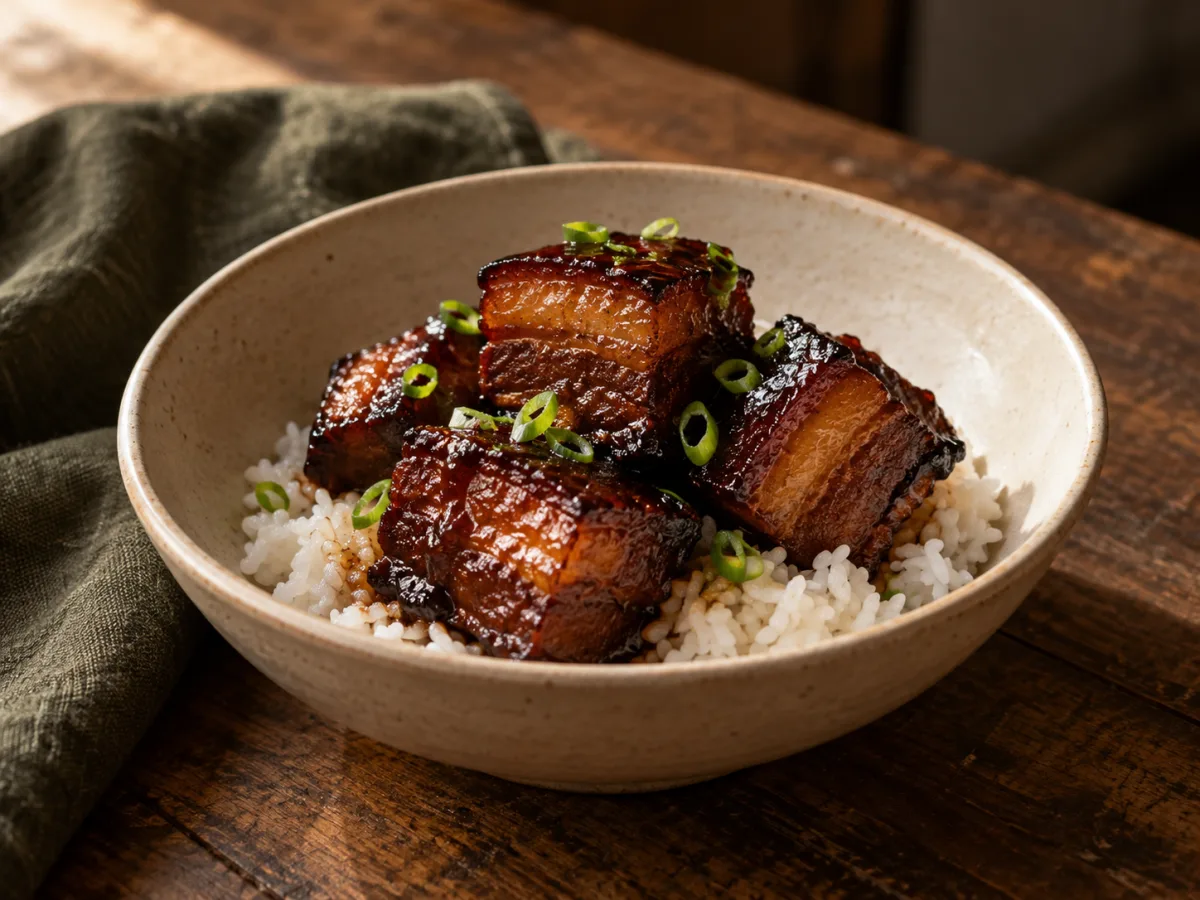
Hong Shao Rou (Red-Braised Pork Belly)
Cubed pork belly blanched, pressure braised in soy, sugar, ginger, star anise, and Shaoxing, then chilled overnight, skimmed, reduced to a lacquer, and finished in the air fryer. Dark, sweet-savoury, and very rich.
Status: untested. Read PREREAD.md first for cooker operation, salt calibration, and the cooling routine.
6 servings, from 1 kg of pork belly. This is a two-day recipe by design — see the fat section.
This is a two-day recipe, and that is the point
Do not try to cook and finish this in one sitting. The overnight chill is a cooking step here, not a storage step, and skipping it produces a genuinely bad dish rather than a slightly worse one. The reason is in the fat section below. Plan it as:
- Day one — blanch, braise, cool, refrigerate. About 105 minutes, nearly all unattended.
- Day two — lift the fat cap, reduce the sauce, air fry, glaze. About 30 minutes.
This suits meal prep better than it sounds. Day two also happens to be the reheat routine, so portions three through six get the same finish as the first one.
Ingredients
For the blanch
- 1 kg pork belly, skin on, cut into 4 cm cubes
- Water to cover
For the pressure cook - 1 x 180 ml portion of chicken stock, instead of the 3/4 cup of water, not in addition — see
chicken-stock.md - 3 tbsp Datu Puti soy sauce (the salt)
- 1 1/2 tbsp dark soy sauce (the colour) — read the soy section if you only have one bottle
- 2 1/2 tbsp brown sugar, or the same weight of rock sugar, crushed
- 3 tbsp Shaoxing wine
- 1 thumb of ginger, sliced into 6–8 coins, unpeeled is fine
- 2 star anise — two, not four, see below
- 6 garlic cloves, peeled but left whole
- 2 spring onions, cut into 5 cm lengths
To finish, day two - 1 spring onion, green part sliced thin
- Neutral oil, a light brushing for the air fryer basket
Method
- Blanch, in the pot. Cubes in, cold water to cover, Sauté on, lid off or resting unlatched. Bring to a boil and hold it 4–5 minutes, skimming the grey scum off the top as it forms. Drain, rinse the cubes under the tap, rinse the inner pot out. Do not skip this — reasoning below.
- Sauté OFF. Per
PREREAD.md, never lock the pressure lid while Sauté is running. - Liquids and seasonings first. Stock (a frozen block is fine), both soys, sugar, Shaoxing. Stir once so the sugar is off the base.
- Solids on top. Pork cubes, ginger coins, star anise, garlic, spring onion lengths. Do not stir again. This pot has no burn sensor and a sugar-heavy braise is exactly what scorches.
- Lid on, valve seated. Meat/Stew, then Pressure Time to 25 minutes.
- Let pressure drop on its own — about 25–30 minutes at this size. Never quick-release. Turn Keep Warm off.
- Remove the star anise, then cool and refrigerate per
PREREAD.md, with the meat still sitting in its liquid. The ginger and spring onion can stay. Lift the inner pot out of the housing first, then divide into two shallow containers. - Next morning, lift the fat cap off in one piece. There will be a lot of it. Keep a spoonful, keep the rest for frying, discard nothing by accident.
- Fish out the remaining aromatics — spring onion lengths and ginger coins. They have given everything they have.
- Lift the cubes out. Reduce the liquid on Sauté, lid resting unlatched, until it is syrupy and coats a spoon — expect 10–15 minutes. It thickens further as it cools, so stop just short.
- Air fry the cubes bare and well drained. Shake the braising liquid off them and blot them dry with kitchen paper — any clinging sauce is sugar, and it will burn long before the fat tightens. Single layer, lightly oiled basket, 190°C for 6–8 minutes, until the surfaces are browned and the fat has firmed. At 1 kg this is two or three batches.
- Sauce goes back on afterwards. Toss or brush the hot cubes with the reduced sauce, then back in for 2 minutes at 190°C. Sauce first and long will burn the sugar; sauce last and short lacquers it.
- Spring onion greens over the top. Serve with rice and something green from the microwave.
Day one is roughly 105 minutes: ~15 blanching, ~25 to reach pressure, 25 cooking, ~30 releasing, plus cooling. Day two is about 30.
The caramel: skipped, and why
The canonical opening move is melting rock sugar in oil until it caramelises to amber, then rolling the pork in it. This recipe does not do that, and the decision was not close.
Sauté cannot do a caramel safely. Caramelisation runs from about 160°C to about 180°C, and the window between amber and acrid is maybe twenty seconds wide. PREREAD.md describes Sauté as weak and non-adjustable, which is exactly the wrong pair of properties: you cannot turn it down when the colour starts moving, and you cannot lift a 3 kg inner pot off a heating element the way you would lift a wok. On top of that the pot is deep, narrow, and dark, so you are judging colour at the bottom of a well. The failure is not a slightly-too-dark sauce; burnt sugar is bitter, unrecoverable, and it is welded to the base of the pot you are about to pressure cook in, which then scorches.
Two things replace it.
- Dark soy sauce supplies the colour. That is largely what it is for — see below. It carries caramel of its own, made properly, by someone else.
- The air fryer supplies the browned sugar. This is the better half of the trade. A caramel at the start gets diluted by 180 ml of liquid and 25 minutes at pressure; the air-fry glaze at the end puts caramelisation directly on the surface you are about to eat, where you can actually taste it. Dry heat on a sugar-coated surface is precisely the job
PREREAD.mdassigns to the air fryer.
What you genuinely lose is a faint bitter edge that runs underneath the whole dish in the traditional version and stops the sugar reading as flat sweetness. The air-fryer glaze recovers most of it but not all, because it is on the outside rather than dissolved through the sauce. If the finished dish tastes one-dimensionally sweet, that is the missing piece — reduce the sauce further next time rather than cutting the sugar, since concentration is what develops those darker notes.
The blanch: kept, and why
The opposite call, for equally practical reasons.
It is easy on this equipment. Boiling a pot of water is the one thing Sauté is unambiguously good at — no browning required, no temperature control required. It costs 15 minutes and one extra rinse of the inner pot.
It matters more here than in a normal braise, because of the reduction. Blanching pulls out blood, soluble proteins, and bone dust, which surface as grey scum. In a soupy dish those get diluted into a large volume of liquid and you barely notice. Here you are boiling that liquid down to about a third of its volume, so anything you fail to remove gets concentrated by a factor of three. Unblanched, the finished glaze reads muddy and faintly livery, and it is cloudy rather than glossy — which matters when gloss is the whole visual identity of the dish.
It also firms the cubes. Setting the exterior proteins helps 4 cm cubes of belly hold their shape through 25 minutes at pressure instead of slumping into a pile, and holding their shape is what makes the air-fry stage possible at all.
The one cost is smell, and it is a plain-boiling-pork smell rather than an appetising one. Fan out of the window per PREREAD.md, and note the smell largely leaves with the water you throw away.
Light soy, dark soy, and what to do with one bottle
Chinese cooking treats these as two different ingredients, and substituting one for the other 1:1 breaks the dish in one of two ways.
- Light soy (生抽) is thin, translucent brown, and salty. It is the seasoning. Datu Puti behaves as a light soy for these purposes — it is Filipino rather than Chinese and slightly sweeter, but its job in a pot is the same, and it is the bottle the folder’s whole salt calibration is built on at 1043 mg sodium per tbsp.
- Dark soy (老抽) is thick, almost black, faintly syrupy, and much less salty per tablespoon — it has been aged longer and usually has molasses or caramel added. It is a colouring and depth ingredient, not a seasoning one. It is what makes red-braised anything actually look red-brown rather than beige.
If you only have Datu Puti, use 4 1/2 tbsp total and no dark soy. The dish will be markedly paler — a mid brown rather than a deep mahogany — and slightly less rounded. Two partial fixes: lean harder on the air-fryer glaze, which browns the surface directly, and stir 1 tsp of molasses or dark treacle into the liquids if you have any, which gets you some of the colour and the faint bitterness without the salt. Do not add more sugar to chase colour. Sugar past this level makes it sweet, not dark, and it will burn in the air fryer.
If you only have dark soy, you have a colouring agent and no seasoning. Use it at the 1 1/2 tbsp written and make up the salt with plain salt — roughly 8 g — tasted in at the reduction stage rather than guessed at the start.
Salt stacking, explicitly. Soy is the only meaningful salt source in this recipe: no oyster sauce, no miso, andchicken-stock.mdputs a 180 ml portion at roughly 200 mg of sodium, which is negligible. 3 tbsp Datu Puti is about 8 g of salt equivalent. Dark soy sodium varies a lot by brand — commonly 60–90% of light soy per tablespoon, so read your label and count 1 1/2 tbsp as roughly one tablespoon of Datu Puti, about 3 g. Total around 11 g across a finished 1.1 kg once the fat is gone, which is a little under 1%. That sits above the folder’s nominal 0.8%, deliberately, because this is served in modest portions over plain rice.
Why pork belly, and not something leaner
The name of the dish translates to red-braised meat, but every version of it is belly, and swapping the cut does not give you a leaner version of hong shao rou — it gives you a different dish.
The layered fat is the texture. Belly is alternating bands of lean, fat, and connective tissue. Under pressure the fat renders soft and the collagen between the bands converts to gelatin, so each cube ends up quivering and semi-translucent, with the fat reading as silky rather than greasy. That specific mouthfeel is what people mean when they talk about this dish. Shoulder gives you tender meat with the fat distributed rather than layered, so it is pleasant but it never gets there. Loin gives you dry strings.
The rendered fat is the sauce. A dish this reduced needs body, and belly supplies both gelatin and fat emulsified into a small volume of liquid. Take away the fat source and the reduction turns into a thin salty syrup that beads off the meat instead of clinging.
The sugar needs fat to work against. 2 1/2 tbsp of sugar in a lean braise reads as sweet. In a fatty one it reads as balance, because fat blunts perceived sweetness and salt. This is the same reason the quantity looks alarming on paper and does not taste alarming in the bowl.
If you must use shoulder, cut it to 5 cm rather than 4, keep the pressure time at 25 minutes, expect to skim far less fat, and accept a looser sauce — a cornstarch slurry per PREREAD.md is a fair patch. It will be a good red-braised pork stew. It will not be hong shao rou.
The fat cap matters more here than anywhere else in the folder
PREREAD.md treats the overnight skim as the step that determines whether you still want to eat portions four, five, and six. In this recipe it is more than that — it is the difference between the dish working and not working at all.
A kilo of pork belly is somewhere near half fat by weight, and a meaningful fraction of that renders out under pressure. When you open the pot you are looking at meat sitting in an oil slick with a little seasoned liquid underneath it. Nothing else in this folder produces that much free fat.
You cannot reduce a fatty liquid into a glaze. Boiling it down evaporates water only; the fat stays. What you get is a smaller volume of greasier liquid, and past a certain point it breaks into visible oil with salty sludge underneath. The lacquer this dish is built around is only achievable from a defatted liquid — that is what reduces cleanly into something glossy that clings.
Chilling is the only tool you have that separates it properly. The tall-jar trick in PREREAD.md works and is fine for the beef braises, but at this fat volume it removes maybe half. Solidified fat lifted off a cold pot in one piece removes nearly all of it, in one motion, with no skill involved.
The palate-fatigue argument also lands harder here than it does in a beef braise, because there is simply more fat and it is a sweeter dish. Rich plus sweet plus greasy is exactly the combination that stops being pleasant on the third mouthful, and the whole batch is six servings.
Keep the fat. It is clean rendered pork fat with soy and star anise in it. A spoonful stirred back into the reduced sauce restores gloss without restoring the slick, and the rest is excellent for frying anything — chicken-stock.md makes the same argument about its own fat cap.
The air-fryer finish
Six to eight minutes at 190°C does two things the pot cannot.
- Tightens the fat. After 25 minutes at pressure the fat is soft to the point of slackness, which some people find unpleasant to eat cold-adjacent. Dry heat firms the surface and drives off surface moisture, so the cube goes from wobbling to holding its shape while staying melting inside.
- Makes the glaze possible. Sauce will not lacquer onto a wet surface; it slides off and pools. Drying the exterior first is what lets the reduction grip.
Drain them properly first. Cubes lifted straight out of the braise are carrying sugary liquid, and sugar at 190°C burns in a couple of minutes — well before the fat has had time to tighten. Blot them dry. Going in bare is not a compromise; it is what makes the browning happen at all, since a wet surface steams.
Glaze late, not early. 2 1/2 tbsp of sugar plus dark soy plus the concentrated reduction is a lot of sugar on a surface at 190°C, and it goes from lacquered to acrid quickly. Brown bare first, sauce second, two minutes maximum. If you want it darker, do another 60 seconds and watch it rather than adding sauce earlier.
Batches. The air fryer is small perPREREAD.md, and a single layer with airflow around each cube is the whole mechanism — crowding steams them. Two or three rounds at 1 kg. Budget 20 minutes and reheat the earlier batches briefly at the end.
Where this departs from the authentic version
- No sugar caramel, replaced by dark soy and the air-fryer glaze. Full reasoning above.
- 25 minutes at pressure instead of 60–90 minutes of simmering. Pressure gets the collagen conversion done far faster, but it does not reduce anything, so the sauce work that a long open simmer does for free has to be done deliberately at the end. That is why the reduction step is written as its own thing rather than as an afterthought.
- Chicken stock instead of water. Folder rule, and free body in a dish that wants a clinging sauce.
- Only 2 star anise, removed before chilling. A recipe written for a 90-minute open simmer will call for more. Whole spices extract much harder under pressure, and star anise in particular goes from warm to medicinal. Pulling it before the overnight rest caps that extraction.
- Shaoxing at 3 tbsp rather than a generous pour. A sealed pot does not evaporate, so alcohol that would boil off in an open braise has nowhere to go. The open reduction is what clears it, and 3 tbsp is what that reduction can handle. If Shaoxing is unavailable, a dry sherry is the closest thing; leave it out entirely rather than substituting anything sour.
- Total liquid exceeds 3/4 cup. 180 ml of stock plus 3 tbsp of Shaoxing is around 225 ml.
PREREAD.md’s rule is a floor against scorching and an argument against adding water; Shaoxing is seasoning that happens to be wet. Documented here rather than pretended away. - The skin stays on.
PREREAD.mdsays skin comes off in the braises, but that rule is about chicken skin going pale and flabby without browning. Pork rind under pressure goes fully gelatinous — it sets rather than slackens — and the air fryer browns it afterwards anyway. Same rule, different material, opposite call.
Notes specific to this recipe
- No black pepper. This is the sweet-savoury branch, and
PREREAD.mdis explicit that sweetness suppresses pepper. Adding it here spends the pepper for nothing. - Go easy on additions generally. No potatoes, no onion beyond the spring onion lengths. Onion’s released water works directly against a dish you are trying to reduce, and its sweetness stacks on sugar you already have.
- Greens are not optional in practice. This is extremely rich and needs something plain next to it. Microwaved bok choy or green beans per
PREREAD.md, never in the pot. - Reheat in the air fryer, not the microwave. This is the exception
PREREAD.mdcarves out for crisped and glazed food. 4–5 minutes at 190°C restores the surface; the microwave turns the tightened fat slack again and you lose the whole day-two stage. Warm the sauce separately and spoon it over. - Freezes very well — arguably better than most things here. Gelatin and rendered fat freeze without splitting and there is no dairy. Freeze the cubes in their reduced sauce, undone, and do the air-fry stage after thawing. Freeze half on day one per
PREREAD.md.
Next-time improvements
Nothing yet — untested. After the first cook, record:
- How much fat came off the cap, by volume, and whether 4 cm cubes were still intact after 25 minutes.
- How long the reduction actually took on Sauté, and how much liquid you started and finished with.
- Whether 2 1/2 tbsp of sugar read as balanced or sweet once the fat was removed.
- Whether the glaze burnt at 190°C for 2 minutes, and what the right air-fryer number is on your unit.
- Whether the blanch was visibly worth it — how much scum came off.
- Whether the sauce read flat without a real caramel, and if so whether a longer reduction fixed it.
- How it ate on day four, which is the honest test for something this rich.