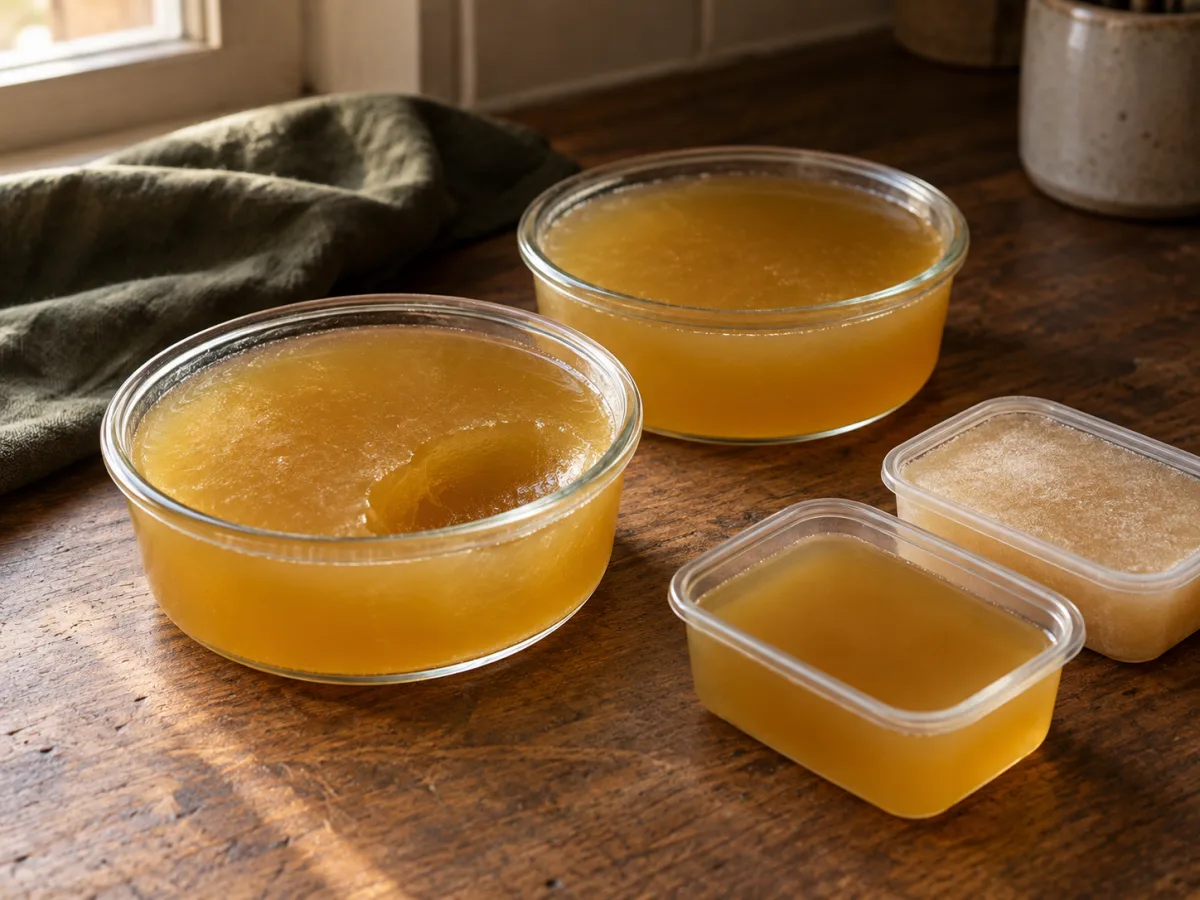
Chicken Stock
Gelling chicken stock from one whole rotisserie chicken, made start to finish in the Dowell. Not a dish — it exists to replace the 3/4 cup of water in pressure braises and to supply body in stock-based sauces.
Adapted from Chris Young’s pressure-cooker stock method, kept as close to his version as the folder’s rules allow.
Status: untested. Read PREREAD.md first.
Expected yield: up to 2 litres, or about 8–11 portions of 3/4 cup. Measure the first batch; this is unverified.
Why bother
Both chicken recipes already name this as the single highest-value upgrade available, and rosemary-chicken.md ranks it #1 on its list of fixes. The reasoning is simple: the 3/4 cup rule means every recipe here has a fixed volume of flavourless water in it. Replacing that with stock costs nothing at the point of cooking — same volume, same method, one ingredient swapped.
It’s worth doing only if two conditions hold:
- It gels in the fridge. The gelatin is what fixes the thin-sauce problem that every recipe in this folder fights. Flavour alone doesn’t do that job.
- You know roughly how salty it is, because the soy quantities here are calibrated to 0.8% salinity and assume the liquid contributes nothing.
Ingredients
- 1 whole rotisserie chicken (~1.2–1.5 kg) — meat, skin, and bones, all of it
- 1.9 L water (2 quarts / 8 cups)
- 1/2 onion, thinly sliced
- 2 garlic cloves, smashed
- 1/2 carrot, thinly sliced — optional, and fine to skip entirely. See below.
- 1 tbsp neutral oil, or saved chicken fat from a previous batch
Before you start — check it fits
A whole chicken plus 1.9 L is the biggest load anything in this folder asks of the pot, and shredded meat and bones take up more room than they look like they will.
Load the solids in dry first and eyeball the max fill line before you add any water. If it’s tight, drop to 1.5 L. Less water gives you a more concentrated stock, which is not a failure — it’s arguably better for this folder, since every recipe here is fighting excess liquid anyway. You just get fewer portions.
Method
- Sauté on. Oil in, then the onion and garlic (and the carrot if you’re using one). Sweat until they take a little colour. Window cracked and fan pointing out before you start — this is the one open-pot step in the recipe.
- Strip the chicken while that sweats. All the meat off the bones, shredded by hand. Meat, skin, and bones all go in. The shredding is the whole trick — see below.
- Turn Sauté OFF. Per
PREREAD.md, never lock the pressure lid while Sauté is running. - Chicken and water in. Cold tap water is fine — see the note on the kettle below.
- Lid on, valve seated. Poultry or Meat/Stew, then Pressure Time to 40 minutes.
- Leave the room.
- Full natural release. Never quick-release. Here it matters twice over: it’s the folder’s main smell control, and a fast release flashes the superheated liquid to a boil, which churns the fat back in and turns clear stock cloudy. Turn Keep Warm off the moment pressure drops.
- Lift the inner pot out of the housing, then strain through the finest sieve you have into two shallow heat-safe containers. Don’t press the solids — pressing pushes fine particles through and clouds it. Let it drip.
- Cool it per
PREREAD.md. Set the shallow containers in a cold-water bath, then refrigerate promptly while still slightly warm. - Next morning, lift the fat cap off in one piece. Keep it.
- Gel test, then portion.
Roughly 2.5 hours elapsed, nearly all of it unattended.
Why the shredding matters
This is the part that makes a 40-minute stock possible, and it’s the step most likely to feel like it isn’t worth the effort. It is.
Extraction rate depends on the ratio of surface area to volume — the same reason you grind coffee beans instead of brewing them whole. Flavour and collagen have to physically travel out of the meat, and shredding collapses the distance they need to cover. A whole carcass simmered for eight hours and a shredded one pressure cooked for forty minutes get to a similar place, because the shredded version removed the barrier rather than waiting it out.
Classical French method says the opposite — whole carcasses, large pieces, eight hours — on the grounds that small pieces cloud the stock. That concern is real at a rolling boil and irrelevant under pressure, because a sealed pot doesn’t boil at all. The liquid sits dead calm, which is what keeps it clear.
Why 40 minutes
Young’s number, and he demonstrates a firm set at around this length, so it’s the safest starting point.
The usable range for chicken is about 30 to 90 minutes, with a hard ceiling at 3 hours. Past three hours three separate things go wrong: the bone structure breaks down and dumps calcium and magnesium into the stock, which reads metallic; proteins fragment into short peptides, which read bitter; and the gelatin itself gets chopped too short to form a set at all, so a 12-hour stock is thinner than a 1-hour one. Longer is not better here — the failure is not subtle.
If your first batch doesn’t gel firmly, go to 60–90 minutes next time, and record it below.
The gel test
Chilled overnight, the stock should be firm enough to hold a spoon mark and wobble as a block rather than pour. That’s the pass condition.
If it pours like water, it failed for this folder’s purposes. It’ll still taste good and it’s fine to use, but it isn’t doing the structural work that justified making it. Cook the next batch longer.
Your chicken is lemon and thyme — read this before committing it
Thyme is fine, and actively useful. PREREAD.md lists thyme among the herbs tough enough to survive pressure cooking, alongside rosemary and bay. It’ll carry through and it suits the direction of at least two recipes here.
Lemon is the one to watch. The folder’s flavour-family rule is that these recipes have no sour note — soy plus garlic plus vinegar is adobo, and this collection deliberately sits somewhere else. PREREAD.md is explicit that when something tastes flat you reach for salt, pepper, or butter, never acid. A lemon-seasoned bird puts a small amount of acid into the stock, against that rule.
Two things work in your favour:
- The lemon aroma is volatile and most of it blows off during the cook and the long natural release. The acidity is non-volatile and carries through, but it arrives without much of the smell that would announce it.
- Dilution. You use 180 ml out of a 2 L batch per recipe — about 9%. Whatever survives lands at roughly a tenth strength.
Taste the cooled stock plain before you commit it to a batch. If it reads clearly citrusy, steer it toward the recipes that can absorb it: - Best fit —
rosemary-chicken.md. Lemon, thyme, and chicken is a classic combination, and this is also the recipe that most needs the stock. - Good fit —
rosemary-garlic-pot-roast-beef.md. Herby Western direction, and thyme is already named there as a valid variation. - Worst fit —
beef-salpicao-style-braise.md. Worcestershire already contributes tamarind acidity; the two will compound. - Middle — the two creamy pepper recipes. Acid doesn’t suppress pepper the way sweetness does, so the risk is lower than it looks. It’s just a note the folder otherwise excludes on purpose.
Salt
Rotisserie chicken is brined, so this will not be a truly unsalted stock. The dilution again works in your favour.
A whole bird carries very roughly 2,000–2,800 mg of sodium. Spread across 2 L and used 180 ml at a time, each recipe receives something in the region of 200 mg — under a quarter tablespoon of Datu Puti at its 1,043 mg per tablespoon. That’s small enough to ignore on the first attempt.
So leave the soy exactly as written the first time, and taste at the end. If the dish reads salty, cut 1/2 tbsp next time and record it. This is the opposite of the advice in creamy-garlic-mushroom-chicken.md about boxed stock and bouillon cubes — those are salted as a product and need a full tablespoon taken off. Yours is only incidentally salty.
Never add salt to the stock itself. Its whole value is being a drop-in replacement for water that doesn’t disturb the salt calibration.
The aromatics, and the carrot question
Young uses half an onion, half a carrot, and two cloves of garlic. The carrot is the one you can drop without thinking about it, and for this folder it’s arguably the better call regardless of whether you have one.
Its only real job in a classical stock is background sweetness. This folder specifically doesn’t want that: PREREAD.md notes that sweetness suppresses the perception of black pepper, and pepper is a lead flavour in three of the five dishes. Half a carrot across 1.9 L is small enough that it probably wouldn’t have mattered either way — but the direction of the error runs against you, not for you.
No substitute needed, and don’t add extra onion to compensate — onion is the other sweet thing in the pot, so that trades one problem for the same problem. Onion and garlic alone make a perfectly good stock.
If you ever make stock for something outside this folder, put the carrot back.
Skin goes in — yes, really
This contradicts both chicken recipes in the folder, which are emphatic that the skin comes off. The reasoning there is texture: unbrowned skin under pressure comes out pale and flabby, and it’s the most off-putting thing you could leave in a finished dish.
None of that applies here, because the skin gets strained out. All you keep is the rendered fat and the gelatin it gives up. Opposite call, same underlying logic.
No kettle, so use cold water
Young boils his water separately and adds it hot, purely to hit a 60-minute target. Everything in this folder happens in the one pot, and this recipe is hands-off anyway, so cold tap water is the right call. It just means a longer come-to-pressure — which is time you spend out of the room regardless.
Yield, portioning, and storage
Expect a little over 2 L — you get back more than you put in, because the shredded meat gives up its own juice.
Portion at 180 ml (3/4 cup). That is exactly one recipe’s liquid, which means no measuring on cook day. About 11 portions per batch.
Freeze flat in small ziplocks. Press the air out, leave a little headroom, lay them flat until solid, then stack them like files. Eleven flat bags take up far less room than the volume suggests, which is the point.
Don’t portion any bigger. At 500 ml you’d thaw a bag, use 180 ml, and have 320 ml left on a 3–4 day clock in a fridge with no space — every single time.
Use it frozen. Drop the block straight into the pot with the other liquids. It’s going into something that takes 25 minutes to reach pressure, so thawing is wasted effort.
Keeps about 3 months frozen, or 3–4 days refrigerated — same window as everything else here.
The fat cap
Keep it. It’s roast-flavoured chicken fat and it has two uses:
- The oil for your next stock batch. Young does exactly this.
- A spoonful stirred into a finished dish.
PREREAD.mdsays to reach for salt, pepper, or butter when something tastes flat. This is a fourth option, and it carries more flavour than butter does.
Using it
Swap it for the 3/4 cup of water. Never in addition — extra liquid compounds the soupiness that every recipe in this folder already has to correct for.
It works in the beef recipes as well as the chicken ones. Chicken stock in a beef braise is standard practice and reads as depth, not as chicken.
Next-time improvements
Nothing yet — untested. After the first batch, record: whether it gelled firmly, how salty it read when tasted plain, whether the lemon carried through, and whether the whole chicken actually fit at 1.9 L.