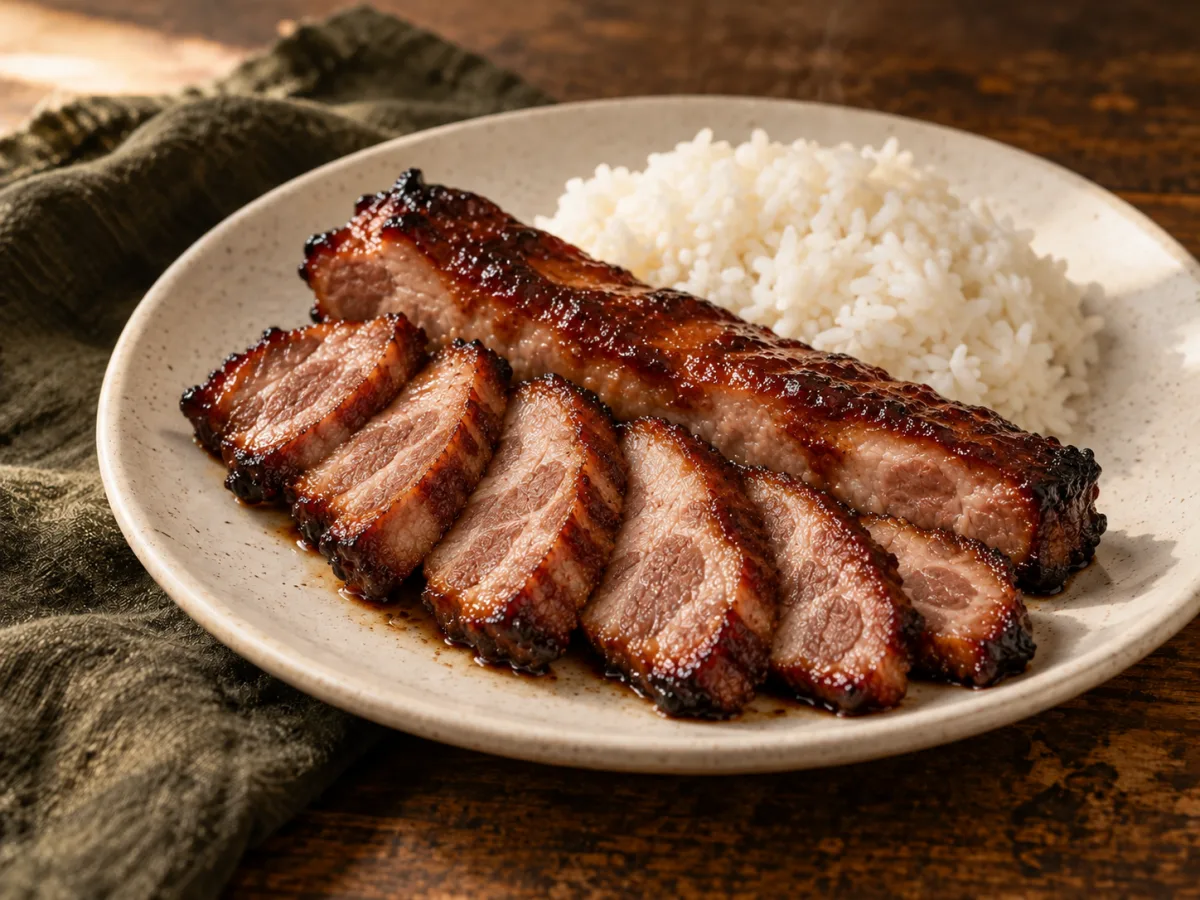
Char Siu
Pork shoulder in long strips, marinated in soy, hoisin, honey, five-spice, and garlic, then roasted and lacquered entirely in the air fryer. No Dowell, no pressure stage, no braising liquid.
Status: untested. Read PREREAD.md first.
6 servings.
Read this before you commit
Real char siu is cooked hanging in a tall gas or charcoal char siu oven at 230–250°C, with radiant heat from the walls, direct flame licking the ends, and smoke in the chamber. That equipment produces the thing people actually want from char siu: blackened, bitter-sweet burnt tips against a soft interior, and a faint smoke note through the whole piece.
An air fryer is recirculated hot air with a ceiling element, topping out around 200°C. It browns well and it sets a glaze beautifully, so the lacquer is genuinely achievable. What it will not give you is the charred edge contrast or any smoke at all. Expect a very good glazed roast pork that reads as char siu, with a flatter aroma and browning that is even rather than patchy. That evenness is the tell — the real thing is deliberately unevenly burnt.
This is the honest version of the same caveat beef-salpicao-style-braise.md opens with. The dish is worth cooking; it just isn’t the restaurant one.
Why no Dowell, and no two-stage pattern
PREREAD.md treats pressure-then-air-fry as the highest-value technique here, so it’s worth saying why it’s wrong for this dish. Char siu is not a fall-apart texture. It’s meant to slice cleanly and chew slightly — you cut it thin across the grain and that’s what makes it tender, not collagen breakdown. Pressure cooking pork shoulder for 30-plus minutes gives you pulled pork, which cannot be sliced and cannot be lacquered.
It would also destroy the seasoning. Everything in this recipe lives on or just under the surface. Under pressure the marinade dilutes into the meat’s released water and ends up in the pot, and a wet piece of pork coming out of a braise will steam in the air fryer rather than glaze. Dry surface is a precondition for lacquer.
Ingredients
The pork
- 1 kg pork shoulder (kasim) or, better, pork collar/neck, cut into strips roughly 5 cm wide, 3–4 cm thick, and as long as your air fryer basket takes — usually 4–5 strips
- Do not use loin. It has no intramuscular fat and comes out dry and stringy at the temperature this needs
For the marinade - 2 1/2 tbsp Datu Puti soy sauce — drop to 2 tbsp if you use the fermented bean curd below
- 2 1/2 tbsp hoisin sauce
- 2 tbsp brown sugar
- 1 tbsp honey
- 2 tbsp Shaoxing wine (optional — see below)
- 1 1/2 tsp five-spice powder
- 6–8 garlic cloves, grated or very finely minced
- 1 tsp grated ginger (optional)
- 2 cubes red fermented bean curd (nam yu) plus 1 tbsp of its red brine, mashed smooth (optional, see below)
Reserved for the glaze — separate this out before any raw pork touches the bowl - 4 tbsp of the mixed marinade
- 2 tbsp honey
- 1 tsp hot water, to loosen
Method
- Mix the marinade in a bowl and whisk it smooth, mashing the bean curd in if you’re using it. Five-spice clumps, so break it up properly.
- Take 4 tbsp out now and set it aside for the glaze. Whisk the extra honey and the hot water into it. This is the only clean portion you get — once raw pork goes into the main bowl, that marinade is no longer brushable.
- Add the pork strips to the remaining marinade and turn them until fully coated. Cover, refrigerate 12–24 hours, turning once if convenient. Under 8 hours and the five-spice and garlic haven’t penetrated past the surface; past 24 hours the salt starts drawing enough water out to firm the texture.
- Lift the strips out and let them drip for a minute. Do not wipe them clean — you want the marinade film, not a puddle. Discard what’s left in the bowl.
- Preheat the air fryer to 180°C. Lay the strips in a single layer with visible gaps between them. At 1 kg this is two batches in most baskets.
- Cook 10 minutes, flip, cook 8 more. Nothing goes on yet. This is the stage that gets the interior to temperature.
- Now start glazing. Brush a thin coat on the up-facing side, cook 3 minutes. Flip, thin coat, 3 minutes. Flip, final thin coat, 2–3 minutes. Watch the last round — this is where it goes from lacquered to burnt.
- Check internal temperature: 72–75°C. Shoulder and collar are forgiving at the top of that range; the fat renders and the strip stays moist.
- Cook the second batch the same way. Then return batch one for a final 3 minutes at 180°C with one more coat — that reheats it and gives it the same number of glaze layers as the second batch.
- Rest 10 minutes before slicing. Slice across the grain at 5–8 mm.
Roughly 80 minutes on cook day, most of it batch time. The 12–24 hour marinade is separate and not counted.
Why strips instead of a whole roast
Two independent reasons, and both are decisive on this equipment.
Surface area. Glaze is a surface phenomenon, and the ratio of glazed surface to meat is the whole eating experience of char siu. A 1 kg roast has one outside. The same kilo cut into five strips has roughly three times the surface, so every slice has lacquered edge on two sides instead of a thin rim. Traditional char siu is cooked in strips for exactly this reason — it was never a whole roast.
Geometry and time. The air fryer basket is shallow and the element is close. A 1 kg roast sits too near the top, blocks airflow around itself, and needs 60-plus minutes of dry convection to reach temperature — by which point the outside is leathery. A 3–4 cm strip is through in under 25 minutes, which is short enough that the surface hasn’t dried out before the centre is done.
Why the glaze goes on in stages
Sugar is the constraint. Honey and brown sugar start browning hard around 150–160°C and carbonise not long after, and the air fryer’s surface temperature is well above that. The interior of a 4 cm strip needs about 20 minutes to reach 72°C. Those two clocks don’t match: glaze applied at minute zero is black at minute ten and bitter by the time the pork is safe to eat.
So the pork cooks naked first, and the glaze goes on only in the last 8–9 minutes, when the surface work is all that’s left.
Thin coats, repeatedly. This is the same logic as varnish. Each thin layer dries, sets, and gives the next one something to grip; three thin coats build a hard glossy shell. One thick coat can’t dry through — the surface skins over while the underside stays syrupy, so it runs off the strip, pools in the drawer, and burns there while the meat itself stays sticky rather than lacquered.
Wipe the drawer between batches. Sugar that has pooled and carbonised from batch one will smoke acridly through batch two and put that flavour into the pork.
Shaoxing wine, and whether it breaks the no-acid rule
It doesn’t, and it’s worth being precise about why. PREREAD.md excludes sour — vinegar-forward profiles, adobo’s tang. Shaoxing is a fermented rice wine whose character is nutty, savoury, and faintly sweet; it carries some acidity, but far below perception threshold at 2 tbsp across a kilo, and most of what’s volatile leaves during a 25-minute cook. The reason behind the rule doesn’t apply, so it stays in.
Two practical caveats. It is genuinely optional — the dish is good without it and nothing else needs adjusting if you skip it. And if your bottle says “Shaoxing cooking wine” it is salted, often 300–500 mg sodium per tablespoon; in that case drop 1/2 tbsp of soy to compensate.
Red fermented bean curd, and what you lose without it
Nam yu is what makes authentic char siu red and gives it a faint winey, savoury-funky undertone that hoisin alone doesn’t have. It’s fermented soy, not fermented fish — the PREREAD.md exclusion names bagoong and heavy patis specifically, and this sits on the other side of that line. It reads as savoury depth, not funk.
If you omit it: the pork will be mahogany brown rather than red, and slightly simpler in flavour. There is no real substitute. Adding food colouring gets the colour and none of the taste, and adding extra hoisin just makes it sweeter. Take the brown version — the colour is cosmetic and the flavour gap is smaller than the visual one.
Salt stacking
Three salty ingredients here, so the arithmetic is worth writing out. Using PREREAD.md’s figure of 2.65 g salt equivalent per tbsp of Datu Puti, and roughly 0.8 g per tbsp of hoisin:
- Without bean curd: 2 1/2 tbsp soy (6.6 g) + 2 1/2 tbsp hoisin (2.0 g) = 8.6 g, about 0.86% of 1 kg.
- With bean curd: 2 tbsp soy (5.3 g) + 2 1/2 tbsp hoisin (2.0 g) + 2 cubes and brine (~1.5 g) = 8.8 g, about 0.88%.
Both land marginally above the folder’s 0.8% target on purpose. Some of the marinade never makes it onto the meat — it stays in the bowl or drips into the drawer — so the effective figure is a little under. More importantly, the 0.8% rule is written for braises where seasoning distributes evenly through a pot. Here it is concentrated on the surface, which is what you taste first and which is meant to read strongly against plain rice.
Notes specific to this recipe
- Grated garlic, not whole cloves. This is a deliberate break from
PREREAD.md. The whole-clove rule exists because minced garlic turns acrid over a 35-minute pressure braise. A marinade is the opposite situation: nothing is cooking, the garlic needs to disperse into a liquid film, and the cook is short and dry. Whole cloves would do nothing at all here. - No black pepper.
PREREAD.mdwarns against making sweet-savoury dishes pepper-forward, and this is the sweetest thing in the folder. A pinch of white pepper in the marinade is traditional and harmless; black pepper is not worth it. - The five-spice is the character. 1 1/2 tsp reads clearly. Below 1 tsp it disappears under the hoisin and you’ve made generic glazed pork.
- Fat cap up on the final flip. Rendered fat runs down the strip and helps the last coat set glossy.
Storage and reheating
Cool and store per PREREAD.md. There is no fat cap to skim here — the fat rendered into the drawer, not into a sauce.
Store the strips whole, and slice after reheating. Slices have far more cut surface exposed and dry out badly on a second pass. Whole strips also keep the lacquer intact.
Reheat in the air fryer, 160°C for 4–5 minutes. This is the case PREREAD.md flags where the microwave rule doesn’t apply: microwaving makes the glaze weep and go tacky, and the surface goes soft. Air frying drives that surface moisture back off.
Freezes well — better than anything saucy in this folder, since there’s no sauce to split or separate. Freeze whole strips, thaw in the fridge overnight, then reheat as above. Keeps 3–4 days refrigerated, about 3 months frozen.
Next-time improvements
Nothing yet — untested. After the first cook, record:
- Whether 18 minutes naked plus 8–9 glazing actually hit 72–75°C, and how much your basket size shifted that.
- Whether three glaze coats was enough for a real lacquer or whether it wants a fourth.
- Whether the last glaze round wanted 200°C for the final 2 minutes to push toward charred edges, and whether that tipped into bitter.
- Whether pork collar was worth sourcing over shoulder.
- How the salt read once sliced and eaten with rice, and whether 0.86% was high or right.