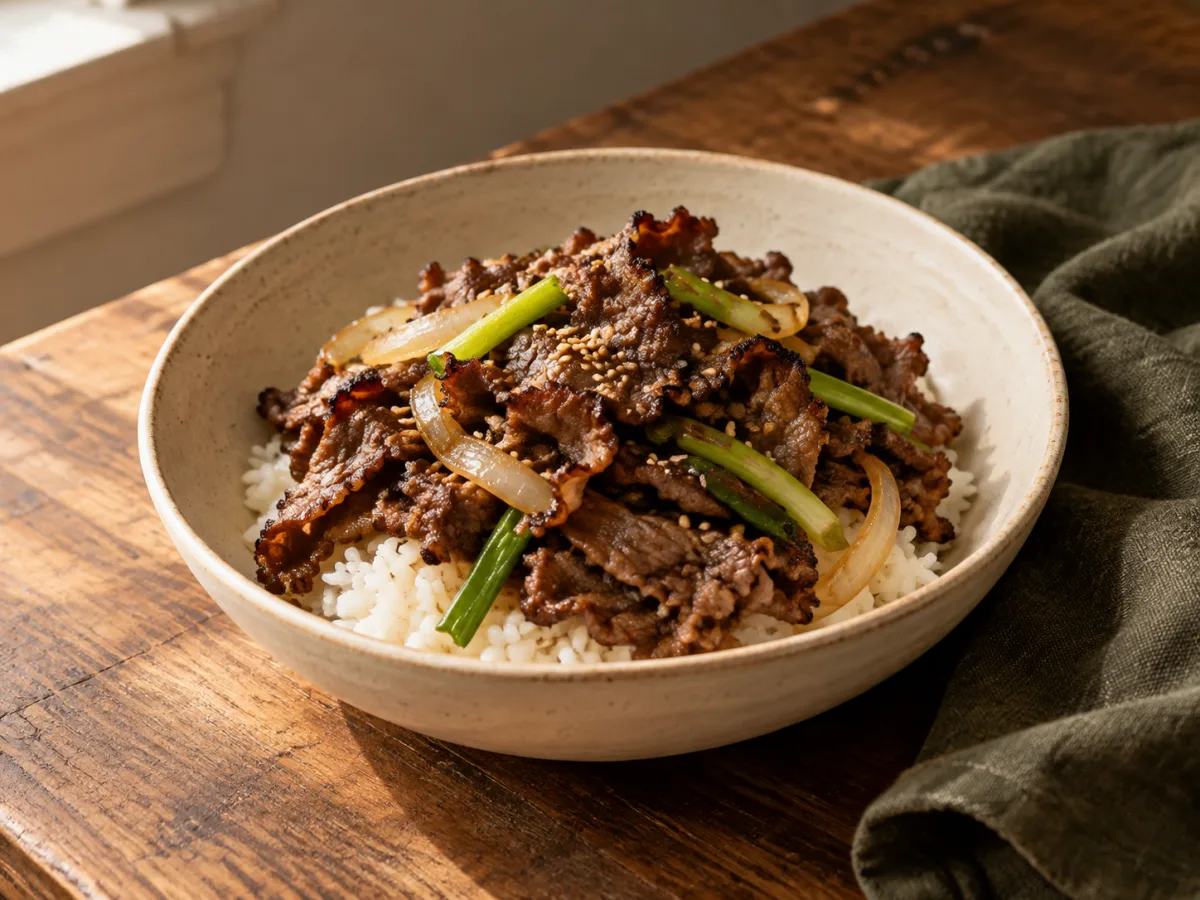
Bulgogi
Thin-sliced beef in a soy, pear, sesame, and garlic marinade, cooked in the air fryer in shallow batches to get caramelisation rather than a grey braise. No Dowell, no pressure stage.
Status: untested. Read PREREAD.md first.
6 servings.
Getting the beef
The slicing is the whole recipe. Bulgogi is 2–3 mm thick, and at 5 mm it stops being bulgogi and becomes chewy soy beef.
- Easiest — buy it pre-sliced. Frozen shabu-shabu, hotpot, or sukiyaki beef from a Korean or Japanese grocery, or the frozen aisle of a larger supermarket. It’s cut on a deli slicer at a thickness you cannot reach with a knife. Thaw it in the fridge and separate the sheets before marinating; a frozen brick will not take marinade evenly.
- Otherwise — partially freeze and slice yourself. Sirloin, ribeye, or chuck eye. Put the whole piece in the freezer for 45–90 minutes, until it’s firm to the edges but a knife still goes through. Slice across the grain with the sharpest knife you own. Firm meat holds still and doesn’t compress under the blade, which is the only way to get thin slices by hand. Fully frozen is too hard and unsafe to cut.
Avoid stewing cuts. This is a fast dry-heat method, so it needs a cut that’s tender to begin with — nothing here breaks down collagen.
Why this must not be pressure cooked
Worth stating plainly, because everything else in this folder goes in the Dowell.
Pressure cooking exists to convert collagen to gelatin, and that takes 35 minutes at temperature. A 2 mm slice has almost no collagen to convert and no thermal mass to protect it. What actually happens is the muscle fibres contract and squeeze out their water long before anything useful occurs, and then keep cooking. You get grey shreds in a watery pot — dry-tasting and mushy at the same time, which sounds contradictory until you’ve eaten it.
It also can’t brown, and the browning is the point of bulgogi. There’s no version of this dish where the Dowell helps.
Ingredients
For the marinade
- 3 1/2 tbsp Datu Puti soy sauce
- 1/2 Korean pear (~120 g), peeled and grated on the fine side of a box grater — or 1 small apple, or see the substitution note below
- 2 tbsp brown sugar
- 1 1/2 tbsp toasted sesame oil
- 8–10 garlic cloves, grated
- 1 medium onion, half grated into the marinade and half sliced thin for cooking
- 1/2 tsp coarsely crushed black pepper — a background note, not a lead
The beef - 1 kg beef, sliced 2–3 mm across the grain (see above)
To finish - 4–6 scallions, cut into 3 cm lengths — greens raw at the end, whites cooked with the beef
- 1 tbsp toasted sesame seeds
- 2 tbsp of the marinade, reserved clean before the beef goes in
Method
- Whisk the marinade — soy, grated pear, sugar, sesame oil, grated garlic, grated onion, pepper. It will look loose and pulpy. That’s correct.
- Take 2 tbsp out and refrigerate it separately. This is your finishing drizzle. Once raw beef is in the bowl, nothing comes back out of it.
- Separate the beef slices and add them, turning by hand until every sheet is coated. Sliced onion in too. Cover and refrigerate 4–12 hours. Two hours works if you’re short. Past 12 hours the pear has done everything it’s going to do and the texture starts to go soft rather than tender.
- Preheat the air fryer to 200°C. Nothing lower — see the crowding section.
- Lift the beef out with tongs and let it drip properly. Do not tip the bowl into the basket. The pooled marinade is what ruins this dish.
- Cook in a shallow, mostly-separated layer. At 1 kg this is 3–4 batches. 5–6 minutes, tossing at the 3 minute mark, until the edges are visibly browned and slightly frilled.
- In the last minute, drizzle a teaspoon of the reserved marinade over the batch and toss. It hits hot metal and caramelises rather than steaming.
- Tip each finished batch into a warm bowl and keep going. Wipe the drawer between batches if sugar has pooled and blackened.
- Off heat, fold through the scallion greens and sesame seeds. The greens stay raw and sharp against the sweetness. Serve over rice.
Roughly 45 minutes on cook day. The 4–12 hour marinade is separate and not counted.
Why the pear matters, and why sugar alone isn’t the same
The pear is doing three jobs at once, which is why it’s worth grating one rather than just adding more sugar.
Browning. Thin beef is cooked through in about five minutes. That is not long enough for Maillard browning to develop from the meat’s own proteins and residual sugars — by the time it would, the slice is overcooked and dry. Added sugar shortcuts this: it browns and caramelises at a much lower activation energy, so you get colour and roasted flavour inside the window the beef can survive.
Tenderising. Asian pear carries mild proteolytic activity that loosens the surface protein structure over several hours. It is much weaker than kiwi, pineapple, or papaya, and that weakness is the feature — kiwi will turn thin beef into paste inside an hour, whereas pear can sit overnight and only improve it. Do not “upgrade” to a stronger enzyme.
Moisture and body. Grated pear holds water against the meat during cooking and gives the marinade enough pulp to cling instead of running straight off.
If you can’t get Korean pear: a grated apple is the standard substitute and does most of the same work. Grated white onion also has some enzymatic effect and you already have onion in the marinade. Pure sugar as the only substitute — 3 tbsp instead of 2 — gets you the browning and none of the tenderising, and it’s noticeably sweeter for the same result. It’s a fallback, not an equivalent.
Crowding, and why it ruins this dish specifically
An air fryer is a convection oven with a fan. It browns by moving hot dry air across a dry surface. Marinated beef arrives wet, and everything that goes wrong here follows from that.
Load 1 kg into the basket at once and you get a wet pile. The mass drops the basket temperature well below 200°C, and it stays down because the fan is spending its energy evaporating marinade instead of heating meat. Water vapour fills the drawer faster than it can be exhausted, so the surface never dries. Surfaces don’t brown while they’re wet — the temperature at the surface is pinned near 100°C until the water has gone. What you get is beef braised in its own marinade: grey, uniformly soft, and flat-tasting, with the sugar diluted into a puddle instead of caramelising on the meat.
Three things prevent it, and all three matter:
- Shallow layer, pieces mostly separated. Overlap is tolerable; a heap is not. This is 3–4 batches at 1 kg and there is no way around that.
- Drain the beef before it goes in. Free liquid in the drawer boils and steams the load from below.
- Preheat, and don’t drop the temperature. 200°C gives you headroom for the inevitable drop when cold beef goes in. Starting at 180°C means you never recover.
Batches are the cost of a small appliance.PREREAD.mdalready says to budget for this at 6-serving scale.
Notes specific to this recipe
- Grated garlic and grated onion, not whole cloves. A deliberate break from
PREREAD.md. The whole-clove rule exists because minced garlic turns acrid across a 35-minute braise; here the garlic needs to dissolve into a marinade film and then cook for five minutes. Whole cloves would contribute nothing. - The onion restriction doesn’t apply either.
PREREAD.mdlimits onion because it turns a dish sweet and pulpy and sweetness suppresses black pepper. This dish is sweet by design and pepper is a background note here, so the reason evaporates. A whole onion is correct. - Pepper stays small. Half a teaspoon. Traditional bulgogi has pepper in it, but
PREREAD.mdis right that sweet and pepper-forward fight; treat it as seasoning, not as a lead. - No oyster sauce, deliberately. Soy is the only significant salt source here, which keeps the arithmetic simple: 3 1/2 tbsp × 2.65 g = 9.3 g, about 0.93% of 1 kg. That’s a touch above the folder’s 0.8% target because some marinade stays in the bowl and some drips into the drawer, so the effective figure lands close to 0.85%. If you switch to Kikkoman or a lighter soy, go to 4 1/2 tbsp.
- Sesame oil goes in the marinade, not at the end. It’s toasted oil, so it’s an aromatic rather than a cooking fat, and a little of it does survive the five minutes. Adding more at the finish makes the dish taste raw and oily.
Storage and reheating
Cool and store per PREREAD.md. Split into two shallow containers rather than one deep one, and freeze half on day one.
This is the better of the two air-fryer beef dishes for meal prep, and the reason is worth understanding. Bulgogi has no crisp coating to lose. Its browning is Maillard colour and flavour developed in the meat surface, not a brittle structure sitting on it, so refrigeration doesn’t degrade it — compare mongolian-beef.md, which loses most of its texture by day two. Bulgogi on day three tastes essentially like bulgogi on day one.
Reheat covered in the microwave. It holds enough marinade and rendered fat to reheat without drying, and there’s nothing crisp for the microwave to spoil. This is the normal PREREAD.md case, not the air-fryer exception.
Fat will set on top of the cold portions. Lift it off before dividing if it looks heavy, though there’s much less of it here than in a braise. Keeps 3–4 days refrigerated, about 3 months frozen.
Next-time improvements
Nothing yet — untested. After the first cook, record:
- The batch count your basket actually needed, and whether 5–6 minutes at 200°C was right or overshot.
- Whether the beef browned or steamed, and if it steamed, whether it was draining or crowding that failed.
- Whether 0.93% read salty against rice.
- Whether pre-sliced shabu-shabu beef beat hand-slicing enough to justify the trip.
- Whether the sugar burned in the drawer badly enough to need wiping every batch.